Annual Report on Meeting Well-being Objectives 2024/25
Contents
Introduction
Note on Section 6 Biodiversity and Resilience of Ecosystems Duty
National Park and its Special Qualities
National Park Authority and Park Purposes
Placemaking Plans
Funding
Measuring Performance – Well-being Objectives
Our Well-being Objectives and their contribution to the Well-being Goals for Wales
Corporate Priority: Conservation
Corporate Priority: Climate
Corporate Priority: Connection
Corporate Priority: Communities
Corporate Areas of Change
Glossary
Introduction
This report sets out Pembrokeshire Coast National Park Authority’s (The Authority) performance in 2024/25 and contribution to its Well-being Objectives. It also shows how we have applied the 5 ways of working under the Well-being of Future Generations (Wales) Act in our work.
We would like to thank staff, Members, volunteers, partners and communities within and beyond the Park for helping us deliver activities highlighted within this document
Note on Section 6 Biodiversity and Resilience of Ecosystems Duty
The Authority has in place an Environmental (Wales) Act 2016 Section 6 (Biodiversity and Resilience of Ecosystems Duty) signposting document that outlines the approach taken by the Authority to embed the duty within its corporate planning framework and reporting. This report constitutes one element of the Authority’s reporting on how it complies with the Section 6 duty. Relevant activities in the report have [Section 6 Duty] noted against them.
National Park and its Special Qualities
Pembrokeshire Coast National Park was designated in 1952 under the National Park and Access to the Countryside Act 1949. The National Park covers an area of 629km2, with approximately 21,000 people living in 49 community, town and city council areas. Most of the National Park is in private ownership with the Authority owning only about 1%.
Pembrokeshire Coast National Park’s special qualities are:
- Landscapes and seascapes of exceptional diversity and quality
- Outstanding coastal scenery
- Distant, uninterrupted views and open horizons
- Beaches
- Spectacular geology and geomorphology
- Rich and varied wildlife
- Tranquillity, soundscapes and wildness
- Dark skies
- Rich heritage and culture
- Welsh language and Pembrokeshire dialects
- Historic patterns of settlement and buildings
- Historic patterns of land use and traditional boundaries
- Excellent opportunities to enjoy and experience the National Park
- A comprehensive network of Rights of Way
- The combination of special qualities
- A sense of community and stewardship
National Park Authority and Park Purposes
The Pembrokeshire Coast National Park Authority was created as a free-standing special purpose local authority under the 1995 Environment Act (the Act). The Authority consists of 18 Members, 12 nominated by Pembrokeshire County Council and six appointed by the Welsh Government.
The Environment Act 1995 specifies that the Purposes of a National Park Authority are
- To conserve and enhance the natural beauty, wildlife and cultural heritage of the park area
- To promote opportunities for the understanding and enjoyment of the special qualities of the area by the public.
The Act also states that in pursuing the above purposes the Authority has a duty to seek to foster the social and economic well-being of local communities.
Placemaking Plans
Every five years the Authority is required to produce a National Park Management Plan. The Plan sets out how it would like to see the National Park managed, not just by the Authority itself, but by the other agencies and organisations whose activities might impact on the Park. A new plan, now called a Partnership Plan was approved by the Authority in March 2025.
The Authority is the statutory planning authority for the National Park and is responsible for the preparation of the Local Development Plan (LDP). The Authority’s Local Development Plan 2 was approved in September 2020, and is monitored through its Annual Monitoring Report.
In 2024/25 the Authority reviewed the LDP in line with regulation requirements. A full revision of the plan was recommended following the review, which will result in a replacement plan LDP3 being prepared. A delivery plan will set out the timetable for the plan revision and community involvement scheme. LDP2 will remain in place until LDP3 is adopted.
Funding
The Welsh Government sets the level of Government funding for the National Park Authority on an annual basis through National Park Grant. For 2024/25, the level of core funding allocated resulted in a flat-cash settlement at the same level since 2020/21 at £3,249k. However, during the year the Authority received a revenue top up of £1.4m (2024: £1,009k) for 2024/25 which ensured the budgeted deficit was prevented.
In setting the amount of National Park Grant, the Welsh Government also determines, in accordance with statutory powers, the minimum amount that can be raised by the National Park Authority as a Levy against Pembrokeshire County Council.
The National Park Grant represents 75% of the Authority’s core grant funding, with the remaining 25% represented by the Levy. This has remained the same at £1.083m since 2021/22. The Authority, however, generates 25% (2024: 23%) of its income locally, for example through car park charges, planning fees and 22% (2024:17%) from other service and project specific grants such as the maintenance of the Coast Path (National Trail). Any deficit or surplus is managed via the Authority’s revenue reserves.
Measuring Performance – Well-being Objectives
The Well-being of Future Generations (Wales) Act 2015 requires public bodies to act in accordance with the sustainable development principles of: Long Term, Prevention, Integration, Collaboration and Involvement. Throughout the document there are examples that demonstrate these principles being applied in practice.
We have also looked to assess our progress towards our well-being objectives through considering:
- Completion of Future Generations Commissioner’s Online Journey Checker tool.
- Future Generations Commissioner’s Future Generations Report 2025
- Audit Wales Reports in terms of 5 ways of working
- Well-being Indicators and National Milestones for Wales
The Authority monitors its progress against its well-being objectives during the year, through performance reports provided to Members through relevant Committees. Some statistics are captured on an annual basis.
The Authority will be reviewing its performance framework in line with the introduction of Welsh Government indicators for 2025/26, updates to delivery plans and to consider how assurance metrics can inform the risk register. The introduction of Welsh Government indicators should support future benchmarking of performance against the other National Park Authority’s in Wales. However, caution is needed due to different variables across the Parks that can impact on performance and delivery in some areas. Further quality assurance work will be carried out with teams to improve accuracy and categorisation of data reported. The Authority has adopted the Welsh Government’s net zero carbon reporting methodology for public bodies for carbon emissions.
Our Well-being Objectives and their contribution to the Well-being Goals for Wales
Development of our Well-being Objectives
The Authority approved a new high-level strategy in July 2021, identifying four priority areas for 2022-26 and a revised vision.
Priority: Conservation – Boosting biodiversity and halting its decline
Impact: Nature is Flourishing
Priority: Climate – Destination Net Zero
Impact: We’re an Authority aiming for net zero and a carbon neutral National Park
Priority: Connection – Natural Health Service
Impact: People are healthier, happier and more connected to nature and heritage
Priority: Communities – Vibrant Communities
Impact: Places people can live, work and enjoy
Vision: A National Park where nature, culture and communities thrive
Online surveys with staff, Members and wider public were carried out as part of its development. In person engagement opportunities were limited due to the impact of the Covid-19 pandemic.
The approval of the high-level strategy triggered a review of our Well-being Objectives. The Objectives were revised to align with the new priorities and to take account of key policy developments and challenges including the nature and climate emergencies. Staff, Members and the Public were consulted on the revised Objectives and associated outcomes. A new set of Well-being Objectives were approved and included in the Corporate and Resources Plan 2022/23. These Well-being Objectives were carried forward to the Corporate and Resources Plan 2023/24 – 2026/27. A set of delivery plans have been put in place to support implementation of the Corporate and Resources Plan.
The delivery plans were subject to detailed review in 2025 following approval of the Partnership Plan, considerations around financial pressures and resilience, project funding updates and learning from the first two years of implementation. This included reviewing progress and priorities with the Senior Leadership Team.
Meeting the Sustainable Development Principles
Long Term: The world is facing a nature and climate emergency; lack of action now will have long term consequences for future generations and the Park. Supporting action to address these challenges is at the heart of our Well-being Objectives.
Prevention: All our Well-being Objectives are focused on delivering interventions that will look to prevent problems occurring or getting worse across the National Park area.
Integration: Our Well-being Objectives can only be achieved by taking a strategic and integrated approach with partners. Our delivery plans support an integrated approach maximising cross cutting impacts across our Well-being Objectives.
Collaboration: We have placed collaboration at the heart of all our Well-being Objectives and delivery plans. From experience we know that positive change can only be achieved through working together with others.
Involvement: Our Well-being Objectives can only be achieved by proactively involving and listening to people. Engagement will be used to ensure we develop the right interventions to break down barriers to support a more diverse range of people to act for nature or experience the outdoors and wonders of the Park.
Below we set out how our well-being objectives in the Corporate and Resources Plan 2023/24 – 2026/27 contribute to the Well-being Goals for Wales, embed the sustainable development principles in practice and our performance against each objective for 2024/25.
Corporate Priority: Conservation
Our Conservation Well-being Objective: To deliver nature recovery and connectivity at scale, so nature is flourishing in the Park, contributing to the protection of 30% of our land and seas for nature by 2030.
Contribution to National Well-being Goals
This Objective aims to deliver the following outcomes:
- Promote and deliver nature recovery on land and in the marine environment supporting the protection of 30% of our land and seas for nature by 2030.
- Favourable conservation status is achieved on high nature value sites.
- Increase in land managed for nature recovery in the Park (achieved through influencing and working with others and managing our own estate.)
- Increase in ecological connectivity.
- A wide range of people are supported to participate in taking action for nature.
- The management of marine designations has improved through working with partners, nationally and locally.
Through maintaining and supporting an increase in nature based interventions in the Park we contribute to a prosperous Wales, resilient Wales, healthier Wales and globally responsible Wales. Contributing to the ‘30×30’ commitment to protect 30% of our land and seas for nature by 2030 and national indicators for Wales on
- Areas of healthy ecosystems in Wales
- Status of biological diversity in Wales with associated National Milestone of: To reverse the decline in biodiversity with an improvement in the status of species and ecosystems by 2030 and their clear recovery by 2050
- Percentage of surface water bodies, and groundwater bodies, achieving good or high overall status
Through supporting a wide range of people to participate in acting for nature and working in partnership with others, including landowners, farmers and communities we support a more equal Wales and a Wales of cohesive communities.
Our activities during the year took account of the wider policy context impacting on conservation and nature recovery:
- UK and Welsh Government’s public commitment to support the 30×30 target of protecting 30% of our land and seas for nature by 2030.
- The recommendations and collective actions developed as part of the Welsh Government Biodiversity Deep Dive.
- Consultation and developments linked to Sustainable Farming Scheme for Wales which will impact on how land is managed for nature in the Park. Development of the Welsh Government Ffermio Bro Scheme.
- The introduction of the Environment (Principles, Governance and Biodiversity Targets) Wales Bill
- Working in partnership with Pembrokeshire Nature Partnership to support delivery of the Pembrokeshire Local Biodiversity Action Plan .
- Development of Biodiversity and the Nature Emergency project within the Well-being Plan for Pembrokeshire.
- South West Wales Area Statement, Marine Area Statement, and State of Natural Resources for Wales Report.
- Officers were involved in shaping the Welsh Government’s Good Practice Guidance on Planning for the Conservation and Enhancement of Dark Skies.
- The LDP2 review report identified need to address changes in Planning Policy Wales regarding securing a net benefit for biodiversity, strengthen policies to protect Sites of Special Scientific Interest, opportunities to increase tree and woodland cover.
The Authority has put in place a Nature Recovery Delivery Plan, with actions in other Delivery Plans supporting more people to take part in action to support Nature Recovery.
Ongoing work is being carried out with the Conservation Team looking at updating schemas and GIS layers in support of us improving our data collection processes and accuracy for figures on land management for nature recovery. This will support future reporting against Welsh Government indicators introduced for 2025/26 and future monitoring linked to 30×30.
2024/25 Progress Towards Fulfilling Conservation Objective
Land Managed for Biodiversity in partnership with Landowners – Conserving the Park [Section 6 Duty]
The Conserving the Park Scheme facilitates practical conservation action on privately-owned sites across the National Park. It increases the resilience of key habitats and species by safeguarding a network of nature-rich sites. It helps landowners who wish to maximise the wildlife value of their land, through tool kit approach that can include formal management agreements.
The total area of private land (non-commons) being managed for biodiversity through Authority help via this scheme in 2024/25 was 2034.46 hectares. The figure excludes sites which have come into Conserving the Park previously, but do not require our active involvement at present.
4 new formal management agreements were made through Conserving the Park scheme in 2024/25 covering 53.06 hectares. This compared to no new formal management agreements being made in 2023/24 due to no spare capacity in management agreement budgets. 100% of conservation sites were in line with their formal conservation management plan in 2024/25, continuing the trend from 2023/24.
There were 12 new sites where we worked with owners for conservation (outside formal management agreements) in 2024/25 compared to 17 in 2023/24. Covering 107.63 hectares in 2024/25 compared to 113.73 hectares (this includes two sites that gave more of their land over to conservation) in 2023/24.
160.69 hectares of new pollinator habitats was created in 2024/25 building on the 113.73 hectares created in 2023/24.
Positive Impact Spotlight: The Authority has been working with landowners along the Nevern Valley to manage and enhance habitats. Together they comprise 67.8ha of almost contiguous habitat managed traditionally without any artificial inputs. Each site has meadows managed for biodiversity surrounded by billowing hedgerows connected to woodland along the valley.
Tree planting has taken place at three sites to further improve woodland connectivity without losing any species-rich grassland, planting will start at another once funding is available. Wildlife ponds have been dug at two sites as part of their systems to manage rain run-off.
Authority Conservation Officers knew from the outset that both greater and lesser horseshoe bats use the Nevern valley; they also suspected that barbastelle bats and dormice could well be present, as both species are features of nearby Pengelli Forest SSSI. All these species rely on woodland networks at a landscape scale to support viable populations. One of our volunteers worked with Natur am Byth to undertake bat surveys in the woodland and discovered that barbastelles are present.
A licensed dormouse volunteer made use of boxes provided by the Initiative for Nature Conservation Cymru to monitor for dormice. A young dormouse was recorded as present during the first survey season.
Other works at these sites have included constructing a night roost for horseshoe bats, opening up an old gateway between adjoining meadows so that cattle no longer pass through (and nibble) an area of young woodland, and monitoring barn owl chicks. The Authority’s Pathways volunteers have done an enormous amount of fencing to enable cattle grazing to be reintroduced. Funding sources have included the Nature Networks Fund, Wild about Woodlands and Local Places for Nature.
Land Managed for Biodiversity in partnership with Landowners – Connecting the Coast [Section 6 Duty]
Funded through SLSP, Connecting the Coast is a land management scheme providing tailored support, advice and funding for biodiversity. Launched in July 2023, the project worked in partnership with local farmers and landowners creating a wealth of opportunities for nature recovery in the Park.
This coastal belt is under pressure from a combination of factors, including high visitor numbers, historical changes in agricultural practices over several decades, coastal squeeze and climate change. Tourism and agriculture underpin the economy in Pembrokeshire and farmland constitutes the largest area, often right up to the fence which separates the fields from the coastal slopes.
Connecting the Coast recognised the need to work with these activities, particularly farming, to achieve effective nature recovery at scale. It was developed as a locally delivered, niche land management scheme in the National Park with the aim of reaching ‘beyond the fence’ and working with local landowners to extend opportunities for nature to thrive in the coastal hinterlands.
The following priorities for delivery were identified:
- Coastal – focus on coastal habitats and species within half a mile of the mean high-water mark.
- Habitat creation and restoration – including species-rich grasslands, coastal grassland, traditional boundaries, ponds etc.
- Habitat management – facilitating long term management of existing habitats, for example coastal slopes.
- Greening of farmland – engaging with farmers to promote nature recovery within productive systems.
Led by the Connecting the Coast Project Officer and Conservation Team Leader, National Park Conservation officers collaborated with our participating landowners to establish:
5-year Management agreements on:
- 75 hectares of coastal slope – supporting some of our most iconic coastal species.
- 45 hectares of hay meadows– providing increased habitat for pollinators, birds, and many other species.
- 60 hectares of species rich permanent pasture – safeguarding both species, carbon stocks and soil health.
- 20 hectares of other habitats including set-aside and semi natural habitat within farms.
- 3 hectares of unsprayed arable margins – protecting one of our most threatened plant species and cultural habitats.
Capital grants to facilitate:
- Over 20km of fencing to support conservation grazing, along with 51 gates and 11 water troughs on key sites requiring livestock to enhance biodiversity.
- Over 150 Hectares of herbal ley, bird and pollinator friendly seed mixes for biodiversity within productive farm systems.
- Almost 3km of new hedging – native species carefully selected to tolerate coastal conditions.
- Restoration of Pembrokeshire stone walls and restoration of ponds and scrapes.
- ‘Special’ projects included the provision of barn owl boxes, tray feeders for farmland birds, skylark information signs and nature discovery kits.
- Purchase of moth traps and other survey equipment to facilitate landowner engagement in monitoring during the next phase of our work.
Positive Impact Spotlight: The Connecting the Coast scheme has supported the Authority to engage with commercial farmers in support of nature recovery. Our 45 Connecting the Coast sites consisted of:
- Commercial farms 60%
- Small holding / private non-commercial holding (33%)
- Tourism provider plus land (7%)
Over half of the sites were commercial farms and we were able to welcome over 20 new landowners who had never worked with the National Park Authority before.
Traditional Boundaries [Section 6 Duty]
Funded by SLSP, the Traditional Boundaries Grant Scheme 2022-2025 offered by the Authority was designed to support landowners and land managers in the restoration and preservation of traditional field boundaries such as stone walls, hedge banks, and earth banks. The scheme provided financial assistance for the restoration of these traditional boundaries, which contribute to the ecological health of the area by supporting habitats for various species, enhancing biodiversity, and improving soil stability. Due to funding availability, the creation and restoration of hedges were prioritised in the 2024/25 year’s scheme.
Interest in the scheme was generated through a Facebook campaign and other media outlets, resulting in 60 initial enquiries, 40 of which were eligible to receive grant support. After a scoring process, 17 landowners were accepted into the scheme. In some cases multiple landowners worked together to plant and safeguard the same hedge.
What was achieved in 2024/25:
- 2,129 meters of hedges planted.
- 12,774 hedging whips planted.
- Hedge laying: 395 meters total across 3 sites.
- Protective Fencing: 3,025 meters total across 12 sites.
A total of 2,524 meters of traditional boundaries were restored under the scheme in 2024/25. Cumulatively 6,282 meters of traditional boundaries have been restored since 2022/23 and 9,960 meters since 2020/21.
SLSP funding for this work came to an end in 2024/25 and further support to landowners on hedges will be provided through the Ffermio Bro Scheme.
Positive Impact Spotlight: The project supported 95m of hedgerow planting and 190m of protective fencing for a hedge near Cas Fuwch. In addition to the hedging whips we were able to support the landowners ambition of creating a wider 4m wildlife corridor through the funding of 2m and trees. These included wych elm, wild crab, cherry and peach, field maple, rowan, sessile oak, downy birch, hornbeam and lime. Although a small hedge it acts as a vital connection from the nearby Heathland Common and Rhos Pasture.
Peatland Action Programme [Section 6 Duty]
The Peatland Action Programme funded project completed at the end of March 2025. Activities in 2024/25 included:
- No Fence collars delivered to farmer for use on Gors Fawr, user agreement signed and risk assessment developed for the site.
- Pony grazing introduced to Mynydd Crwn common.
- Fencing repairs done at March Pres following damage from falling trees, so site is secure for grazing.
- No Fence collar training delivered to farmers in June in preparation for use of collars on peatland sites during the summer.
- Fencing work carried out at Felin Wern and Dyffryn Brynberian. A gateway access point into the peatland area has been installed at Felin Wern so cattle can get access to graze.
- At Dyffryn Brynberian, volunteers spent a day clearing brash so that the area could be grazed and / or Himalayan balsam cut regularly.
- At Gors Fawr, vegetation cutting has been undertaken to make the site more accessible to ponies, so they can graze the rank areas.
Collaboration Spotlight: The Pembrokeshire Grazing Network capitalises on established relations between landowners and Graziers to ensure that land is managed for conservation purposes. During 2024/25, 403 hectares were managed by grazing across 67 sites throughout the National Park. The Pembrokeshire Grazing Network relies heavily on ponies to deliver targeted grazing but over the past year the network has facilitated goats and cattle using no fence collars to graze at some sites.
Commons Resilience [Section 6 Duty]
In 2024/25 there were 3,771.4 hectares of access land where the Authority supported commons management partnerships. This is a decrease on 3,792.51 hectares in 2023/24, reflecting improvements in mapping accuracy.
Funding was secured via the Heritage Lottery – Nature Networks Fund for activities to support commons resilience. As part of this the Authority completed two fencing projects in Gernos Fawr and Blaen Ffynnon.
Collaboration Spotlight: The Pembrokeshire Wildfire Group, chaired and coordinated by the Authority, is a multi-agency partnership that brings together land managers, emergency services, and public bodies to address wildfire risk through proactive land management, training, and coordinated response planning. In March 2025, the group facilitated a controlled burn at the Authority’s Penlan site. This was not only an important land management exercise but also served as a valuable live training opportunity for Mid and West Wales Fire and Rescue Service (MAWWFRS) personnel. Improving readiness and strengthening inter-agency coordination ahead of the main fire season. In late March, a large wildfire broke out on the northern slopes of the Preseli Hills, burning for several days and impacting a significant area of open access land. Officers from the Authority were on-site for two days, supporting the MAWWFRS with specialist equipment and local knowledge to help contain the fire. During the Preseli incident, previously installed firebreak infrastructure, developed by the Authority as part of its conservation and risk mitigation work, played a key role in slowing the spread of the fire and creating access for firefighting operations. This demonstrated the tangible benefits of investing in long-term landscape management for wildfire resilience.
Stitch in Time [Section 6 Duty]
Funded by the Heritage Lottery Fund: Nature Network grants 2 and 3 and the SLSP grant, the Authority’s Stitch in Time project is successfully controlling two invasive nonnative plants, Himalayan balsam and Japanese Knotweed.
The project is focussing Himalayan balsam control over 8 Pembrokeshire catchment areas and continues to monitor and maintain near eradicated states of balsam in Cwm Gwaun and Porthgain.
53.43 hectares were under high intensity control (cutting Himalayan balsam) during the 2024 growing season across catchment sites. An increase on 35.26 hectares in 2023/24. Monitoring and maintenance for invasive species was undertaken across 28.79 hectares in 2024/25 an increase on 11.77 hectares in 2023/24. 1,246 Japanese Knotweed stems were injected.
During 2024/25 the project continued to engage volunteers in removing invasive species. Contractors were also engaged with to carry out vegetation cutting at sites to create access for control work.
Positive Impact Spotlight: At a location in Blaenffos, one season of thorough cutting by contractor and follow up with project officer has reduced the density of balsam significantly. Foxgloves, grasses, nettles and dead nettles are starting to thrive at the site following removal of competition from balsam.
Collaboration Spotlight: The Authority continued to provide financial support and participate in the Pembrokeshire Nature Partnership. The Authority’s Lead Ecologist chairs the partnership. This partnership supports delivery of Pembrokeshire Nature Recovery Plan. Officers working on behalf of the partnership have developed, submitted and secured a revenue and capital programme under Welsh Government’s Local Places for Nature Scheme. This funding contributes to projects, that support delivery of local nature recovery plan and Authority nature recovery projects have benefited from it.
Positive Impact Spotlight: The Local Places for Nature funding supported the Little Haven Lichen Project. Goultrop Roads, part of De Porth San Ffraid / St Bride’s Bay South SSSI, is the only substantial ancient woodland on the open coast in Pembrokeshire. Locals and visitors make use of this site along the Pembrokeshire Coastal Path to experience calm and tranquillity, even at the height of the tourist season. It is nationally important for epiphytic lichens and is a site where they are thriving. It holds the largest populations in the county of several Red Data List species and the largest in Wales for the rare Degelia atlantica. 10% of the entire Welsh population of Lobaria virens grows here. However, lichens are under threat from the spread of invasive non-native laurel and rhododendron, casting a dense shade where they grow.
Using funding from Local Places for Nature, the invasive species were stem injected with herbicide by specialist contractors using rope access for some areas. The funding paid for 175 hedgerow whips which volunteers planted along the edge of the woodland, as a buffer between it and the adjacent arable land. This will protect the woodland from any agricultural inputs. 15 larger tree specimens were planted in ‘Cactus’ guards on nearby National Trust land at Sheepfields, to provide suitable habitats for lichens in the future (they were selected on account of their bark pH). The site is pony grazed without artificial inputs, which will maintain the light conditions and clean air needed by lichens.
The History Points website created a page about the lichen community, which the public can access via a QR code on the public footpath sign.
Nature Recovery and 30×30 Impacts [Section 6 Duty]
Several of the Authority’s Nature Recovery projects delivered via external funding ended in March 2025. During the year officers worked on bids for SLSP and NNF4 projects that have been successful and will support our nature recovery work and ambitions. These successful bids included
- Commission a 30×30 report for the Park. Assessing current progress against the 30×30 target and providing recommendations and action plan to provide Authority with a clear pathway to achieving the target. It will include recommendations for future monitoring and reporting on our progress.
- Commission mapped 10 year nature recovery connectivity strategy.
- Habitat monitoring pilot involving identification of methodologies
Completing these activities will allow the Authority to align its nature recovery projects and monitoring to meeting 30×30 ambitions. Helping ensure the Authority is maximising and evidencing its contribution to the 30×30 targets.
Collaboration Spotlight: The Authority continued to provide funding towards the Pembrokeshire Marine Special Area of Conservation, Cardigan Bay Special Area of Conservation and Carmarthen Bay and Estuaries European Marine Sites (Special Protection Area and Special Area of Conservation) and attend relevant meetings. The Authority’s contribution helps fund the SAC Officer post which in turn unlocks the ability to access external funding. In 2024/25, the SAC Officer delivered:
- Native Oyster project (funded by SLSP and aiding restoration efforts by Natur am Byth! project)
- Seagrass e.g. maintenance of existing moorings to protect seagrass in Pembrokeshire (funded by Natur am Byth! project)
- Surveying the Waterway Environment for Pollution Threats (SWEPT) – 156 sites in Pembrokeshire were tested in November/December 2024 with 354 instances of voluntary surveyor effort (funded by Natur am Byth! project). Volunteers also sampled 51 sites in Ceredigion and 70 sites in Carmarthenshire / Gower (funded by Nature Networks Fund – Improving Marine Protected Areas).
- Otters – coastal citizen science project plus subcontractors in Pembrokeshire, Carmarthenshire, Gower and Ceredigion (funded by Nature Networks Fund – Improving Marine Protected Areas).
Collaboration Spotlight: The Authority participates in the Cleddau Nutrient Management Board in support of the successful implementation of the Nutrient Management Plan. The Nutrient management Board is working to improve favourable conditions status of SAC catchments while facilitating nutrient neutral development in the Park.
Nature Recovery in how we operate
Asset Management Strategy and Policy [Section 6 Duty]
There was no change in the property owned or leased by the Authority managed for biodiversity in 2024/25 with it remaining at 503.25 hectares.
During 2024/25 the Authority approved an updated Asset Management Policy and Strategy. Both documents provide a framework to help ensure that the Authority’s management of assets contributes to improving biodiversity.
The Authority has implemented a grounds maintenance procedure for Llanion Park to support the management of part of the site as a hay meadow and improve other areas for wildlife.
Managing the Paths for Nature Recovery [Section 6 Duty]
The Coast Path and Inland Rights of Way network offers a great opportunity for the Authority to explore how it can manage access work in a way that also supports nature recovery.
142 pollinator/ habitat improvement Countryside Management work programme tasks were completed in 2024/25, in support of managing the Coast Path and Inland Rights of Way Network for nature recovery. This compares to 128 tasks in 2023/24. This included ant hill, bee banks and scalloped edges work programme tasks. Despite the Authority no longer having a specific pollinator warden this activity has now been mainstreamed into wider rights of way cutting work programme. Work is ongoing to explore how to further embed this within the Countryside Team approaches.
Archaeology and Nature Recovery [Section 6 Duty]
Vegetation encroachment is problematic for many archaeological sites because it causes disturbance and displacement of archaeological features and increases deterioration in the condition of sites. Species that are problematic for scheduled monuments can also prove problematic for nature, such as creating a monoculture or reducing biodiversity.
The Community Archaeologist with the support of volunteers and other officers is working to reduce and clear problematic species at several sites, benefiting both the historic and natural environment.
Positive Impact Spotlight: Clearance of bracken and gorse at Mill Haven Rath, Tower Point Rath and Crugiau Cemmaes have led to an increase in native species, such as Foxgloves. Work tackling Himalayan Balsam and Japanese Knotweed at a medieval leat in St Davids will improve the condition of the monument but also help slow the spread of these invasive non-native species within the Alun River catchment area.
Felling a diseased beech tree next to the south tower at Newport Castle was done sensitively, so that disturbance to potential bat roosts was minimised, a four-metre habitat stump was also retained to help support nature.
Ash Dieback [Section 6 Duty]
Targeted ash dieback surveys have been completed on all Authority owned sites with zoning according to the usage of these sites and hence the risk to public safety. Outcomes from a survey will result either in continued annual monitoring, more frequent monitoring or removal of tree.
Tree work identified as necessary within the tree inspection surveys at Authority sites for 2024/25 was undertaken in line with the ongoing work programme.
Strategic Approach [Section 6 Duty]
The Authority will look to review the Section 6 Biodiversity Duty Signposting document in 2025/26 following approval of the Partnership Plan in March 2025.
Supporting people to appreciate and protect nature [Section 6 Duty]
10,662 volunteer and social action hours were contributed to nature recovery in the Park and surrounding area in 2024/25. This a 52% increase on the 7,019 hours in 2023/24.
Volunteer wildlife monitoring and activities included bees, moths, beetles, Skylark transects, wild asparagus, wetland birds, otters, reptiles, yellow hammers, door mouse, harvest mouse, chough, seals, butterfly transects and SSSI woodland monitoring.
There were 1,723 participants in outreach/ inclusion programme sessions and activities facilitated by the Authority that focused on appreciating and protecting nature and biodiversity in 2024/25. This was a decrease from 3,487 in 2023/24 and is linked to decreases in early year participation due to fall in number who attended the play day at Llys y Fran. Activities included practical fencing for nature, hedge laying, scrub clearance and Balsam pulling by Pathway participants. For Roots to Recovery participants this included litter picking, gardening activities and walks supporting people to experience nature.
There were 2,895 participants in community engagement sessions and activities facilitated by the Authority that focused on appreciating and protecting nature and biodiversity in 2024/25. This compared to 1,716 in 2023/24. This included building habitat log pile with members of congregation of St Mary’s Church, Carew Cheriton and Friends of the National Park volunteers support for Balsam pulling.
There were 3,920 participants in learning programme sessions and activities facilitated by the Authority that focused on appreciating and protecting nature and biodiversity in 2024/25. This compared to 3,476 in 2023/24. This included beach studies, woodland studies, river studies and practical sessions involving bug hotel creation, tree and hedge planting, pond creation and bird box making.
There were 7,291 participants in public and visitor sessions and activities facilitated by the Authority that focused on appreciating and protecting nature and biodiversity in 2024/25. This compared to 2,400 in 2023/24. This included seal walks, nature related trails, biofluorescent night walk, discovering bumblebee walk, and brilliant bats at St Davids events.
Through the Connecting the Coast Project the Authority has increased the scope of its engagement with landowners, building on its previous work through the Conserving the Park Scheme. Interventions as demonstrated in the examples above consider the role connectivity plays in supporting nature recovery. Effective collaboration remains at the heart of the Authority’s approach to nature recovery on land and sea. The securing of NNF4 and SLSP funding will support the Authority to further align its approaches and interventions to meeting 30×30 commitments. Ongoing monitoring by staff and volunteers continues to play an important role in assessing the impact of our interventions and in identifying areas requiring further action.
Corporate Priority: Climate
Our Climate Well-being Objective: To achieve a carbon neutral Authority by 2030 and support the Park to achieve carbon neutrality and adapt to the impact of climate change.
Contribution to National Well-being Goals
This Objective aims to deliver the following outcomes:
- PCNPA to be a carbon neutral Authority by 2030.
- PCNPA has supported the Park on its pathway to becoming carbon neutral as near as possible to 2040.
- The National Park is made more resilient to the impacts of climate change by working with partners and supporting work led by the Public Services Board.
- Engagement activities with staff and wider public have led to behaviour change.
Through supporting the Authority and Park to become Carbon neutral we are supporting a prosperous Wales ambition for Wales to be a low carbon society. We are also supporting a globally responsible Wales and a healthier Wales. Contributing to Welsh public sector ambition to reach net zero greenhouse gas emissions by 2030 and national milestones for Wales:
- Wales will achieve net-zero greenhouse gas emissions by 2050
- Wales will use only its fair share of the world’s resources by 2050
Carbon sequestration activities that also benefit nature recovery support a more resilient Wales. Building resilience in terms of climate adaptation supports a more resilient Wales and a Wales of cohesive communities.
Our activities during the year took account of the wider policy context impacting on climate change and decarbonisation:
- Welsh Government’s ambition for public bodies collectively to be carbon neutral by 2030 and its ‘Routemap for decarbonisation across the Welsh Public Sector by 2030’ and the ‘Net Zero Wales Carbon Budget 2 (2021-2025.)’
- Wider Welsh Government national strategies on circular economy , transport and Just Transition to Net Zero Framework.
- Introduction of Socially Responsible Procurement Duty and changes to UK procurement legislation.
- The Climate Change Risk Assessment for the UK, Climate Adaptation Strategy for Wales and Pembrokeshire Climate Adaptation Strategy.
- Development of Decarbonisation and Net Zero project and Climate Adaptation project within the Well-being Plan for Pembrokeshire.
The Authority has put in place a Decarbonisation Delivery Plan and Adapting to Climate Change Delivery Plan.
2024/25 Progress Towards Fulfilling Climate Objective
Authority’s Carbon Emissions – Overall Trend Analysis
The Authority uses the Welsh Government Net Zero emissions submission calculation and framework to work out its corporate carbon emissions for the year.
The Authority’s decarbonisation team are carrying out work to enhance both data collection, methodology tiers and analysis to support future reporting and identifying opportunities for reductions. This has meant that waste has been recorded separately from supply chain emissions for the first time. They have trailed a new way of coding expenditure against SIC code accounting for budget codes for supply chain calculation. Size of car and fuel has been added to expenses claim form for improved data analysis of business travel and to move to the higher tier 3 calculation methodology.
The data in this section reflects the data submitted as part of the 2024/25 submission. Please note 2024/25 data referenced below has not yet been reviewed by Welsh Government and figures are influenced by changes in calculation methodology across years.
When emissions are not offset against land removals, the Authority’s emissions were 1,500,430 kg CO2e – an increase in emissions of 15% compared to 2023/24.
| Category | 2023/24 kg CO2e |
2024/25 kg CO2e |
Difference |
| Buildings and Streetlighting – Grid Electricity | 94,216 | 74,366 | -19,850 (-21% ⇓) |
| Buildings – Heat & Fuel | 19,575 | 68,937 | 49,362 (+252% ⇑) |
| Buildings – Water | 763 | 705 | -58 (-8% ⇓) |
| Fleet and Equipment | 86,749 | 100,310 | 13,561 (+16% ⇑) |
| Business Travel | 17,851 | 20,962 | 3,111 (+17% ⇑) |
| Commuting | 131,547 | 135,610 | 4,063 (+3% ⇑) |
| Homeworking | 21,930 | 24,815 | 2,885 (+13% ⇑) |
| Waste | Previously reported via supply chain | 11,696 | Previously reported via supply chain |
| Supply Chain
(Spend Based Calculation) |
936,843 | 1,063,029 | 126,186 (+13% ⇑) |
| Total Emissions | 1,309,476 | 1,500,430 | 190,955 (+15% ⇑) |
The three main categories contributing to this increase in emissions were
- Supply Chain, which constitutes 71% of our overall emissions. Caution is needed when looking at supply chain emission figures as it is based on a Tier 1 spend based methodology with means there is a 25% relative standard deviation value applied to it, due to accuracy variables. The increase is due to improved recording and data coding which means we are getting a more accurate picture of our spend based emissions. The two biggest supply chain emission categories reflect an increase in capital expenditure and were for
Manufacturing, which is 60% of our spend based supply chain emissions.
Professional, Scientific and technical activities, which is 17% of our spend based supply chain emissions.
- Buildings – Heats and Fuel, which constitutes 5% of our overall emissions. An increase from it only constituting 1% of our emissions in 2023/24. Oriel y Parc saw a significant increase in natural gas use, due to its ground source heat pump having failed. Llanion also saw an increase. Authority through SLSP funding will be looking to install low carbon heating option at Oriel y Parc.
- Fleet and Equipment, which constitutes 5% of our overall emissions. Unfortunately, the trend for using EV vans has gone down in the last 12 months and there has been an increase in diesel van use. We are investigating the cause of this. 40% of the Authority’s vehicles are electric/ hybrid. Officers carried out work in 2024/25 to progress introduction of telematics to fleet vehicles, this should support future analysis on fleet use and options for potential emission reductions.
Positive Impact Spotlight: The Authority received an accessible Electric Vehicle Minibus in 2024/25 to replace an old diesel minibus, alongside a new electric estates van.
Land removal and emissions are treated as outside scope within the Welsh Government reporting. However, when emissions (adding in land use emissions) are offset against land removals based on the submission data the Authority’s emissions are 218,346 kg CO2e.
| Category | 2023/24 kg CO2e | 2024/25 kg CO2e | Difference |
| Land based removals | – 1,286,368 | -1,286,368 | 0 (0⇒) |
| Land based emissions | 4277 | 4,284 | 7 (+0.16% ⇑) |
The Authority did see a reduction in its grid electricity usage and associated emissions. Oriel y Parc saw a 43% reduction in its grid electricity usage, reflecting positive impact of renewable energy production following its solar panels being repaired. It should also be noted that the reduction in electricity use at Oriel y Parc can be partially attributed to the ground source heat pump failure. Llanion Park saw a 11.64% increase in its grid electricity usage. Both Oriel y Parc and Llanion Park have the highest electricity consumption and emission rates for grid electricity. Progression of work to install photovoltaic solar canopies at both sites should have a longer term positive impact in helping reduce our overall grid electricity emissions and associated energy costs.
| Category | 2023/24 kWh | 2024/25 kWh | Difference |
| Onsite renewables – electricity | 5,514 | 16,496 | 10,982 (+199% ⇑) |
| Onsite renewables – heat | 189,326 | 183,149 | -6 (-3% ⇓) |
| Purchased renewables – electricity | 342780 | 272,862
|
-69,918 (+20%) |
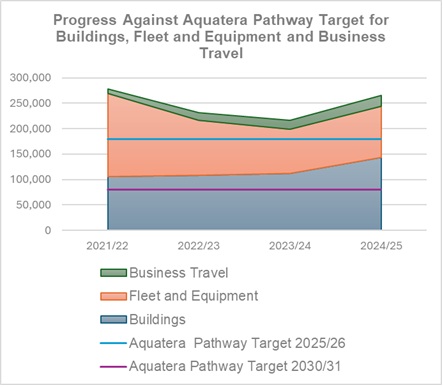
The Authority needs to reduce its Buildings, Fleet and Equipment and Business Travel emissions by 85,280 kg CO2e to meet the Aquatera Pathway target for these categories for 2025/26 and by 185,280 kg CO2e to meet the Aquatera Pathway target for these categories for 2030/31.
Positive Impact Spotlight: Salary sacrifice scheme for staff purchasing Electric cars is now available as part of staff benefit. Authority has started to see some take up of the scheme.
Positive Impact Spotlight: Before implementing new sustainability initiatives, uniforms for team members and volunteers were not always sourced with environmental concerns in mind. Many uniforms were not recyclable, and once they reached the end of their life cycle, they were either discarded or went to waste due to being branded. The organisation lacked a comprehensive system to manage this waste, leading to a negative environmental impact.
Through the introduction of a brand-new collection and laundry system, over half of the uniforms required by teams and volunteers are now sourced from recycled stock. This sustainable approach helps reduce waste and minimises the need for new production of uniforms. Additionally, for uniforms that cannot be recycled, they are repurposed by sewing volunteers and donated to a local Warm Clothing Hub. In rare cases when items cannot be salvaged, they are repurposed by a waste service to ensure no material is wasted. This initiative is helping to significantly reduce the environmental footprint of the organisation, particularly by diverting waste from landfills. New team members told us they preferred to have recycled kit. [Section 6 Duty]
Positive Impact Spotlight: As part of a wider departmental restructure, several teams needed to be relocated within Llanion Park. However, the process posed challenges related to excess waste, inefficient document storage, and underutilised space. The goal was to ensure a smooth transition while integrating sustainable practices to minimise waste and improve operational efficiency. Through careful planning and implementation, we significantly reduced waste, repurposed resources, and optimised space usage across Llanion Park. Staff were encouraged to apply key waste principles when clearing their areas, ensuring responsible disposal and reuse wherever possible. Additionally, excess office furniture was repurposed, and minimal new purchases were made through effective maintenance and repair strategies:
- Reduced unnecessary office chair replacements by engaging supplier to conduct maintenance and re-gassing at a lower cost than purchasing new chairs.
- Diverted substantial amounts of recyclable waste from landfill, including stationary materials, books, wood, metals, and electronic equipment.
- Donated excess office furniture to VC Gallery, supporting veterans and community art initiatives. [Section 6 Duty]
Carbon Literacy and Behaviour Change
Carbon Literacy activities were impacted in 2024/25 due to changes and vacancies within the decarbonisation team. However, it is expected that this area of work will recommence in 2025/26 and to increase capacity as part of volunteer review officers have been exploring potential role that volunteers could play in supporting delivery. Members of management team were able to benefit from free carbon literacy training with external provider via Cynnal Cymru and Academi Wales in 2024/25.
Community Decarbonisation Projects – SDF [Section 6 Duty]
Funded through SLSP, the Authority’s Sustainable Development Fund supports community led projects that contribute towards a reduction in carbon and help respond to the climate emergency. 10 SDF community decarbonisation projects were completed in 2024/25, this compares to 11 in 2023/24. 7 new projects were approved for funding by the Grants Committee in 2024/25.
A map is available on the Authority’s website providing details of the projects supported by the SDF fund.
Positive Impact Spotlight: Theatr Gwaun in Fishguard aimed to improve its energy efficiency by maximizing the benefits of its rooftop solar array. With support from SDF Grant the theatre installed a battery storage system and addressed a pigeon nesting issue that had been compromising performance. They aimed to increase the theatre’s use of its own solar power during high-demand periods, prevent feral pigeons from nesting under the panels and damaging the array, reduce energy costs and improve sustainability as part of its Climate Action Plan. They Installed five 4.6kWh SolarEdge batteries (23kWh total capacity) and two inverters. Cleared nesting debris, repaired damage, and added protective netting around the solar array. They retrofitted the battery system to the existing solar setup.
In their final project report, they reported to have already generated 18.03 MWh of solar energy and stored and used 3.36 MWh from batteries, cutting grid export by a third. They also reported lowering operational costs and an increase in public interest had been noted.
Positive Impact Spotlight: Cilrath Acre set out to install a full access compost toilet to support its community growing project. The aim was to reduce waste, improve comfort for volunteers and visitors, and enhance the overall accessibility of the site. Thanks to funding from SDF Grant and match support from Milford Haven Port Authority’s Green Energy Fund, the group successfully purchased and installed a Natsol compost toilet. The facility aligns with the project’s core principles of sustainability and circular systems, improving user experience while reinforcing environmental values. Despite an unexpected VAT cost that exceeded the original budget, the charity covered the shortfall to complete the project. The outcome has significantly enhanced comfort and dignity for users, strengthened volunteer retention, and improved access—particularly benefiting older individuals and those with specific health needs. The project contributed to the community by donating fresh produce to a local foodbank, supporting wellbeing and climate action through volunteering, and enhancing community engagement and biodiversity. Moving forward, the team plans to conduct feedback surveys, host events, and involve local groups to make the most of the improved facilities. Volunteer Feedback:
“Having our new ‘Super Loo’ on site has saved me precious time and energy… It’s also satisfying to know human waste becomes nutrient within our circular permaculture system.”
“Nobody was more delighted to see the arrival of the compost toilet than me.” (Male volunteer with a prostate condition shared the vital importance of nearby facilities.)
Milford Haven Native Oyster Regeneration Project [Section 6 Duty]
Funded through SLSP, this project aimed to restore the once-abundant population of native oysters within the Milford Haven Waterway and, in doing so, improve the condition of the Pembrokeshire Marine Special Area of Conservation. This work is being carried out in partnership with Bangor University, the Pembrokeshire SAC Officer and Tethys Oysters in Angle Bay, and formed part of the Blue Carbon Strand of the Authority’s Wild Coast! Sustainable Landscapes, Sustainable Places funded project.
After more than a year of careful rearing, thousands of juvenile native oysters have now been returned to the Milford Haven Waterway, marking a major milestone in this ambitious restoration project.
Since the project began in late 2023, Bangor University’s School of Ocean Sciences has been nurturing native oyster broodstock collected from Angle Bay and Burton Ferry. These oysters spawned multiple times in controlled conditions, producing hundreds of thousands of larvae. The tiny larvae were then reared until they were ready to settle on to shells, where they mostly remain fixed as they grow. Some scallop shells held as many as 160 individual oyster spat, ranging from 4mm to 10mm in size.
In February, an estimated 200,000 baby oysters were released into the Waterway by students from Paddle West. The team successfully transported the oysters to their deployment site in shallow water where they were laid by hand. Atlantic Edge Oysters will oversee a selection of the young oysters to assess their growth rates.
The Authority is continuing to fund the development of further spat with plans to deploy more Oysters.
Positive Impact Spotlight: Through the Natur am Byth monitoring programme we’ve recently had confirmation that the Oysters are on the bed of the waterway and still thriving.
Greening Agriculture Project
The Greening Agriculture project used SLSP funding to support renewable energy installations at dairy farms, including heat recovery systems and solar photovoltaics with battery storage. During the latest grant allocation 7 farms have been supported to improve carbon outputs through efficiency enhancement and renewable energy provision.
Positive Impact Spotlight: One demonstration Farm operates a spring calving dairy herd with a grass-based grazing system. They currently milk 380 Frisian cross cows and focus on soil health and grass management. With the help of the grant, a heat recovery system was installed that converts excess heat from milk cooling fans into hot water. This system has significantly reduced energy consumption for water heating, essential for washing the parlour and milk tank. The system heats water from 5°C to 65°C, saving approximately 45kW per day or 16,425kW per year.
Sustainable Transport
A feasibility study into low carbon route in South East Pembrokeshire including how this could be funded was part of a successful SLSP bid. It will be exploring and investigating access to work transport barriers and solutions in Tenby.
The Pembrokeshire Public Cycle E-Bike scheme, delivered in partnership with the Authority, continued to support the transition to low carbon travel. Thanks to additional funding in 2024, the scheme expanded to Saundersfoot, Broad Haven, and New Hedges. Between April 2024 and May 2025, 856 rides were recorded across the original towns, despite a temporary four-month suspension in Haverfordwest due to vandalism. The E-bike Hire scheme pilot at Oriel y Parc continued in 2024/25 during the spring and summer months. 5 e-bikes were available for people to hire. A review meeting was held to look at opportunities to invite interest from local businesses, community groups, community interest companies to operate the e-bike hire scheme within the National Park area.
In terms of promoting sustainable transport in the Park:
- Authority collaborated with Transport for Wales on the promotion of the Carew Castle Express, a new train promoting a route into West Wales.
- Coast to Coast features a sustainable transport section, including promotion of the Flexibus scheme
- Project funding has been received by Visit Pembrokeshire to develop a marketing initiative with Transport for Wales/Great Western Rail to develop a ‘Come to Pembrokeshire by train’ campaign, and the Authority will be involved in supporting the content development and wider promotion of this campaign.
Collaboration Spotlight: The Authority continued to provide financial support to the Greenways Partnership, Coastal Buses and Tenby Park and Ride service in 2024/25.
The Partnership secured for 2024/25 the return of two popular bus services to the Pembrokeshire Coast
- The Puffin Shuttle (service 400) running between St Davids and Marloes, via Little Haven, Druidstone, St Brides and Martins Haven
- The Strumble Shuttle (Service 404) runs via the coast road between St Davids and Fishguard, including Abereiddy, Porthgain and Strumble Head.)
Total passenger number figures for 2024/25 were 81,352:
- 387/8 Coastal Cruiser (Daily summer, 2 days winter): 7,696 (6,986 in 2023/24)
- 400 Puffin Shuttle (Daily summer only): 8,899
- 403 Celtic Coaster (Daily summer only): 25,052 (28,939 in 2023/24)
- 404 Strumble Shuttle (Daily summer only): 5,884
- Tenby Park and Ride (Daily summer only): 33,821
Collaboration Spotlight: The Authority continued its involvement with the Corporate Joint Committee for South West Wales whose remit includes working on a regional level to improve regional planning and co-ordination for transport. The Strategic Policy Manager has engaged with development of the draft Regional Transport Plan 2025-2030. During 2024/25 the Corporate Joint Committee undertook a public consultation exercise on the draft plan, providing people with an opportunity to have their say on the future of transport networks in South West Wales.
Positive Impact Spotlight: The installation of EV charging points to create a county wide network was completed in 2022/23. The network is designed to give thorough coverage across the county of Pembrokeshire to address the EV charging needs of residents, visitors and to support and encourage the transition to electric vehicles. The Authority has seen a continued increase in usage of the charging points installed in its car parks. They were used 11,633 times in 2024/25 an increase of 39% on 8,367 in 2023/24 and 75% increase on 6,634 in 2022/23.
Dark Skies Pembrokeshire Project [Section 6 Duty]
Following a survey in August 2023, the SLSP programme provided capital funding to support the delivery of light pollution reduction activities. This included areas of high wildlife sensitivity in coastal locations. Light pollution can impact negatively on health, wildlife and ecosystems and waste energy.
Pembrokeshire County Council agreed to a trial program of changing the lighting on their public toilets, starting at Newgale and Whitesands. These were identified as locations which had a high number of stranded Manx Shearwater fledglings recorded in 2024. Manx Shearwaters are drawn to lights which can result in Manx Shearwater fledglings grounding. Newgale is listed as a Dark Sky Discovery Site for star gazing. The existing lighting were large round, wall mounted bulk heads where approximately 50% of the light was emitted into the night sky. These were replaced with dark skies friendly Tamlite downlights.
Pembrokeshire’s first Dark Sky Discovery Site was designated at Broad Haven South on the Stackpole estate. Project lighting designers were commissioned to identify detailed lighting schemes for National Trust buildings at Stackpole Estate. The National Trust were supplied with dark skies friendly light fittings for properties on the Estate extending to the Stackpole Centre, Quay Cottages and the Old Stable flats. An element of funding was also provided towards the installation and maintenance of the lighting.
As part of Prosiect Nos, St Davids was identified as an area where significant improvements were needed to reduce light pollution. Through Prosiect Nos lighting was retrofitted at the three campus sites of Ysgol Penrhyn Dewi. SLSP funding supported the replacement of bollard lights at the exterior of Ysgol Penrhyn Dewi Non Campus with dark skies friendly light bollards.
Surface mounted floodlights overlooking the Authority’s Llanion Park offices car parks were replaced with dark skies friendly Tamlite downlights.
As part of the project technical support and practical guidance have been provided to a wide range of partners, including land managers, tourism operators, military bases, and local authorities, helping to reduce light spill and promote the ecological, cultural, and economic benefits of dark skies.
Decarbonisation engagement [Section 6 Duty]
3,616 volunteer and social action hours contributing to decarbonisation/ removals in 2024/25, this compares to 2,873 in 2023/24. This includes community tree planting, tree planting as part of wider nature recovery activities, hedge planting and litter pick activities.
Positive Impact Spotlight: A tree planting project to commemorate the Park’s 70th anniversary concluded at the end of April, with more than 1,500 trees planted in community spaces and gardens around the National Park. On the Pencaer peninsula, a community planting and giveaway event was held at St Nicholas Village Hall in April. Local residents were able to choose from four species of tree to take home with them.
There were 343 participants in outreach/ inclusion programme sessions and activities facilitated by the Authority that focused on climate, decarbonisation, behaviour change and sustainability in 2024/25. This compares to 152 in 2023/24. This included tree planting, litter picking and hedge laying activities with Roots to Recovery, Pathway and Youth Ranger participants.
There were 572 participants in community engagement sessions and activities facilitated by the Authority that focused on climate, decarbonisation, behaviour change and sustainability in 2024/25. This compares to 162 in 2023/24. This included tree planting activities with volunteers as part of nature recovery activities.
There were 2,411 participants in learning programme sessions and activities facilitated by the Authority that focused on climate, decarbonisation, behaviour change and sustainability in 2024/25. This compares to 1,232 in 2023/24. These included sessions focused on Lost Words exhibition, renewables discovery day and practical tree and hedge planting activities. Including 250 Greenhill school pupils from Year 7 and 8 taking part in tree planting activities.
There were 8,315 participants in public and visitor sessions and activities facilitated by the Authority that focused on climate, decarbonisation, behaviour change and sustainability in 2024/25. This compared to 6,570 in 2023/24. This included Glow at Carew where visitors were also able to power some of the decorations in the walled garden themselves, by jumping on a bike and generating pedal-powered energy. Oriel y Parc hosted seasonal markets supporting local craft makers and arts and craft workshops. Castell Henllys hosted a sustainable living day.
Positive Impact Spotlight: Oriel y Parc introduced Make & Take sessions, family-friendly workshops designed to unleash creativity while fostering a connection to the natural world. By repurposing everyday materials, participants explored ways to reduce waste while crafting unique nature-inspired creations.
Collaboration Spotlight: Authority has been working with other National Park Authorities on application for the UN backed “Race to Zero” initiative. Committing to drive action to halve carbon emissions within their landscapes by 2030 and become significant net carbon sinks by 2050. The UK wide National Park submission to Race to Zero were approved. Small World Consulting have created a tracker portal for territorial emissions data for tracking performance and progress.
Climate Change Risk Assessment for National Trail
Funded through SLSP, the Authority commissioned a detailed Climate Change Risk Assessment of the National Trail from Netherwood Associates. The Assessment examined the exposure of the 186-mile route to erosion, flooding, infrastructure damage, and user safety issues under future climate scenarios. Sixteen adaptation actions and key hotspots were identified, laying the groundwork for further research between 2025 and 2030 to test and implement targeted responses.
Pickleridge Lagoon Adaptation Options Appraisal
Funded through SLSP, the Authority commissioned consultants to assess the coastal adaptation options at Pickleridge on the Dale Peninsula. This site consists of a shingle ridge which is held in position by rock armour defences constructed in the 1970s by Pembrokeshire County Council. The rock armour revetment which protects the seaward side of the ridge is now at the end of its design life and is showing evidence of local failure. The scale and frequency of maintenance required to maintain the pedestrian route along the ridge, and to cross the Gann at low tide, are likely to increase in coming years as extreme high-water levels become more frequent in association with sea level rise and climate change.
The coastal adaptation planning undertaken by the consultants identified long-term risks associated with the aging revetment and recommended a managed adaptation approach involving partial revetment removal, the creation of a controlled breach, and the construction of a new flood bund. This work led to the formation of a stakeholder group, including the Authority, Natural Resources Wales, and Pembrokeshire County Council, to pursue collaborative, adaptive management of this dynamic and sensitive site.
Responding to Coastal Erosion and Poor Weather Conditions
The Authority continued to carry out activities to increase resilience of paths and to respond to the impact of coastal erosion and poor weather conditions on them. Realignment activities include getting relevant SSSI consents and making Public Path Diversion Orders. During 2024/25:
- Footbridge installed to bridge unstable section of Coast Path at the Mariners, Newport. Replacement footbridge installed at Castle Beach Dale (longer span to withstand abutment erosion) with more durable steel bearers. Rotten timber bridge replaced at Norchard, near Lydstep by a durable steel beam bridge with recycled plastic deck and handrails.
- Llangwm Ferry path was closed following storm erosion in May. Engineering solutions were identified by Officers.
- Welsh Government funding was secured for detailed geological investigation to be commissioned at Monkstone Beach path to explore options for public footpath reinstatement. Monkstone Beach Access geological survey report received and is being considered to inform next steps.
- Winter storms resulted in cliff erosion in two places near Dinas which will necessitate realignment of Coast Path – landowner contacted and survey being undertaken.
- Storm Darragh caused unprecedented and widespread damage. Dozens of paths were obstructed by fallen trees and a large tree fell and destroyed a footbridge near Moylegrove. Wardens worked to clear trees with complicated tasks requiring specialist contractors and plant.
Asset Management and Climate Risks
A Coastal Car Park Study commissioned by the Authority was completed. It involved a review of charging car parks and identification of opportunities linked to managing climate risk and resilience, installing renewable energy options and flood risk mitigation.
The Authority new Asset Management Strategy includes an objective on:
- Identify the risks, including climate change and liabilities, involved with ownership and management and ensure that these are properly taken into account.
LDP2 Review Report
The Local Development Plan policy framework relating to flooding and climate change includes Policy 34 (Flooding and Coastal Inundation) which is the overarching strategic policy, aimed at directing development away from those areas which are at risk from flooding. It is reinforced by Policies 35 (Development in the Coastal Change Management Area), Policy 36 (Relocation of existing permanent dwellings affected by coastal change), and Policy 37 (Relocation and replacement of development (other than residential) affected by coastal change). These supportive policies designate “Coastal Risk Management Areas” and make allowances for the relocation and replacement of homes and community facilities, helping to enable the coastal communities in the National Park adapt to the effects of climate change
The LDP 2 review report presented to Members at the March 2025 National Park Authority meeting identified a need to update evidence to take account of Strategic Flood Consequences Assessment and Flood Map for Planning which will inform the LDP’s strategy and proposals. The replacement plan will also consider the viability of requiring zero carbon market homes.
Young People and Climate Heritage Risks
The Authority, in partnership with the Museum of London Archaeology and Futureworks, were successful in obtaining funding from the Arts and Humanities Research Council to deliver an engagement project with young people focussing on heritage at risk due to climate change. The project commenced in January 2025 and will conclude in June 2025. The Futureworks participants aged 16-20 are learning about the impact of climate change at monuments across the National Park area, including St Brides, St Davids, Angle and Whitesands Bay. The theme of loss is explored and the techniques used by archaeologists to mitigate against climate change.
As an outcome of the project, the participants are being supported to create social media content to raise awareness of the issue. It is hoped that the content created will resonate with a group that is often underserved and underrepresented in archaeology. The project also aspires to help the participants develop skills and experience that will help empower them with their future development. The participants are supported by Futureworks, MOLA and National Park Authority staff.
Statement of Effectiveness
The Authority has seen an increase in its carbon emissions for 2024/25, some of this reflects improved recording. It has secured funding for several building projects that once implemented should support decreases in building related emissions and help reduce energy costs. The decarbonisation team will need to carry out further work with relevant teams to identify how we can reduce emissions tied to fleet usage and supply chain.
Data gathered to inform Race to Zero will help the Authority and partners in the future assess progress in terms of decarbonisation in the Park. The Authority’s Sustainable Development Fund grant has proven an effective mechanism for enabling community led decarbonisation activities to be carried out in the Park and surrounding area. Collaboration at a regional and local level will remain important when looking at sustainable transport opportunities.
The Authority has improved its evidence base in terms of climate risks for coast path and car parks which can help inform future approaches and assessments of risk and financial impacts.
Corporate Priority: Connection
Our Connection Well-being Objective: To create a Park that is a natural health service that supports people to be healthier, happier and more connected to the landscape, nature and heritage.
Contribution to National Well-being Goals
This Objective aims to deliver the following outcomes:
- People are supported to lead a more physically active lifestyle by accessing the National Park, through promoting sustainable outdoor recreational opportunities.
- People are supported to report that accessing the National Park has had a positive impact on their health and wellbeing.
- The Authority has helped address where possible the barriers that can impact on people from diverse backgrounds or facing socio-economic disadvantage from connecting with nature and heritage opportunities in the Park.
- Provide support to enable people of all ages to develop an understanding of the National Park.
- Infrastructure is maintained, including the Public Rights of Way network, heritage assets and access points to enable people to continue to gain access to and enjoy the National Park.
- Historic assets in the National Park are protected and appreciated.
Supporting people to access the physical and mental well-being benefits of the outdoors and engaging with nature and heritage contributes to a healthier Wales and a Wales of vibrant culture and thriving Welsh Language. Breaking down barriers to assist a more diverse range of people to take action for nature and heritage or experience the Park supports a more equal Wales, Wales of cohesive communities and a resilient Wales. Contributing to National Indicators for Wales on:
- Percentage of adults with two or more healthy lifestyle behaviours
- Percentage of people who volunteer
- Mean mental well-being score for people
- Percentage of people who are lonely
- Percentage of people attending or participating in arts, culture or heritage activities at least three times a year
- Percentage of designated historic environment assets that are in stable or improved conditions
- Active global citizenship in Wales
Our activities during the year took account of the wider policy context impacting health and well-being, learning and access to outdoors and heritage opportunities:
- South-West Wales Area Statement and role access to green and blue spaces can play in supporting improved health outcomes.
- Publication of National framework for social prescribing
- The Curriculum for Wales and the ‘what matters statements’ across the six areas of learning and experience.
- Welsh Government’s Term of Government Remit Letter for the National Park Authorities that stated it would like to see all bodies working with under-represented audiences and communities.
- Welsh Government’s Equality related plans, and Authority’s own Equality Plan.
- Development of the Reducing Poverty and Inequalities project within the Well-being Plan for Pembrokeshire.
- Rights of Way Improvement Plan.
- Welsh Government Priorities for the historic environment of Wales.
- LDP2 review report identified need to address changes in Planning Policy Wales regarding the identification and protection of strategic green infrastructure.
- Development of local strategies – Pembrokeshire Age Friendly Communities Strategy and Pembrokeshire Volunteering Strategy.
The Authority has put in place a Health, Well-being and Access Delivery plan and Engagement, Involvement and learning about the Park Delivery Plan. With actions in Pembrokeshire Life Delivery Plan and Communications and Marketing Delivery Plan also contributing to this Objective.
2024/25 Progress Towards Fulfilling Connection Objective
Open to All Accelerator Project
This was a partnership project between the Authority and Visit Pembrokeshire funded by UK Shared Prosperity Fund. The Open to All project worked with businesses and organisations to make Pembrokeshire the first choice for residents and visitors who face barriers to travel and tourism. During 2024/25 the project offered
- A range of training sessions, including Deaf Awareness and BSL, Website accessibility, accessibility awareness, sight loss awareness, mental health first aid and neurodiversity training.
- Facilitated bespoke events, including Watersports open day, BSL tour of Carew, Mobiloo tour.
- Carried out audits.
- Developed a resource hub.
Positive Impact Spotlight: The project facilitated a Mobiloo Tour across sites in Pembrokeshire. Mobiloo is a mobile accessible toilet and changing facility designed to enable disabled individuals to participate in events and outings with dignity and independence. It includes features such as a hoist, adult-sized changing bench, and an accessible toilet. The primary aim of the Mobiloo tour was to raise awareness among businesses and members of the public about the importance of accessible facilities. The Mobiloo team met people who shared their experiences and challenges in finding accessible spaces. The survey the team carried out showed that many participants had not heard of or seen a Mobiloo before, and that 89% would be more likely to attend an event if one was present. Feedback included:
“The freedom and dignity this provides to families like ours cannot be overstated.” “Seeing the Mobiloo in action is inspiring. It’s a game-changer for accessibility.”
Get Outdoors Scheme
The Get Outdoors Scheme has enabled the Authority to continue its supported walking activities following the ending of the West Wales Walking for Well-being project. There were 3,015 participants in supported walking programme in 2024/25, compared to 3,545 in 2023/24. In its first year it has established new walking groups, while existing ones have been reinvigorated. A focus has been on widening access, engaging with individuals who are often disconnected from other services and face multiple barriers to participation. Volunteers continue to play an important role in leading these walks.
Positive Impact Spotlight: Following the Black Girls Hike visit to St Davids in September 2024 through the Open to all project, new Global Majority walks have been established. These are designed to be safe, welcoming, and community-led, and are set to expand as trust grows. Discussions are underway with Pembrokeshire Pride to develop a similar walking offer for the LGBTQ+ community.
Weekly Parent and Baby walks were established. The walks have created a community for new parents to help with getting outside and fighting isolation. One father said “these walks really help you get out of the house, it can be so easy to be isolated and stuck inside all day. These walks are great”. Another mother said “these walks have really helped my mental health post baby”.
Staff led accessible walks are held weekly at rotating locations around the Park. A participant on the accessible walk was able to enjoy a walk with their grandson, supported by the Get Outdoors team. The team introduced them to PACTO’s Green Dragon Community Transport, restoring independence they thought was lost. They shared that “I felt normal for the first time in 5 years.”
The Get Outdoors Scheme also co-ordinates the Authority’s beach wheelchair and mobility equipment offer. Our mobility equipment provision is supported by local hosts such as cafes, surf clubs and hostels. There were 427 beach wheelchair and mobility equipment bookings, in 2024/25 compared to 399 in 2023/24, a 7% increase. The team attended several events to promote the service during 2024/25 including sessions arranged as part of Open to All project. New hosts for 2025 include Bluestone who are hosting and supporting the maintenance of our previously underused mountain trikes and acting as a venue for future accessible walks.
Positive Impact Spotlight: Mobility equipment supported adapted beach sessions with Tonic Surf and Blue Horizons for 47 young people visiting from England all with additional needs.
The Health and Well-being officer has been continuing to review and develop meaningful relationships with health and other local support organisations. This includes engaging with Public Health Wales Hapus platform.
Infrastructure
The Authority contributed £110k to Pembrokeshire County Council for public toilets as part of year 1 of a 2 year agreement. It also commissioned an assessment of several of its car parks. This included exploring for shortlisted sites opportunities linked to inclusivity and accessibility in terms of ramps, signage, incorporation of changing places for disabled people and beach wheelchair rentals. The Authority’s current focus is on an ongoing project at Traeth Mawr. This project has faced some delays, however further funding has been secured to enable delivery of phase 1 and 2 together.
Marketing Resources
Photography and filming commissions were completed at all three visitor attractions. A new bank of diverse imagery/films are available for use, showcasing the visitor offer and representing the diversity of audiences. These resources are being used across the Authority publications, marketing and website resources, including in the Coast to Coast 2025 publication.
Outreach and Social Inclusion Work
There were 2,620 participants in our inclusion, outreach and increasing access for underrepresented groups sessions, compared to 1,677 in 2023/24. These sessions have included art workshops at Oriel y Parc, Open 2 All events, a range of outdoor activities and guided walks.
There were 954 participants in our learning programme, inclusion and outreach activities, compared to 450 in 2023/24. This included session with Springboard clearing roundhouse at Tenby Woods, staff attending career events, guided walks and practical social action conservation sessions.
There were 366 participants in our next generation activities – engagement with young people, compared to 448 in 2023/24. This included sessions with Youth Committee, Youth Rangers, Duke of Edinburgh, Point Youth Group, Futureworks, Action for Children, Scouts and Cubs. Ranging from engagement meetings, outdoor activities and practical volunteering sessions.
There were 772 attendees at Castell Henllys quiet hour sessions in 2024/25, compared to 664 in 2023/24. These sessions give people an opportunity to experience the Iron Age with no loud or noisy activities or demonstrations.
Roots to Recovery
The Roots to Recovery partnership project with Mind Pembrokeshire and Carmarthenshire funded by the National Lottery continued in 2024/25. Taking a partnership approach this project supports the mental health of local people through a range of outdoor experiences at locations in and around the Park. Roots to Recovery is a people centred project so participants suggest and choose the activities they would like to do with activities including gentle strolls to beach games, practical conservation work, gardening or exploring the National Park. Participant numbers are always high, and activities are well attended. Each session is planned to achieve all the five ways to wellbeing.
Positive Impact Spotlight: Participants report that their mood and mental health improves because of connection with others, physical activity in the outdoors and involvement in local projects. The engaging programme is designed to allow participants to grow their confidence and skills with participants becoming Volunteer Mentors. Impact on participants captured in following Roots to Recovery You Tube Video: https://www.youtube.com/watch?v=sRYpDj130wk&t=19
As part of our review of the Authority and Mind Pembrokeshire’s Roots to Recovery project, the project team spoke to representatives from the ‘carer community’ in Pembrokeshire. They heard from several groups, and it was clear that for some, the opportunity to spend time outdoors offered the potential for much needed respite time and a boost to wellbeing. Building on the partnership with Mind Pembrokeshire and their Children and Young People initiative, they heard directly from young people who had benefitted from spending time outdoors as part of the Roots to Recovery programme to benefit both mental health and wellbeing. In August of 2024 the project contacted Action for Children, who support young carers from 8 to 25 in Pembrokeshire. The charity runs groups as well as supporting individuals and families in the County. Working with Action for Children helped inform the development of a bid with Mind for National Lottery Community funding for the Routes to Discovery Project.
Positive Impact Spotlight: Since Autumn 2024, we have delivered 5 outdoor sessions with young carer groups in Pembrokeshire. We were able to work the 11- to 16-year-old young carers group (who are based at the Picton Centre in Haverfordwest) on three occasions. Focusing on experiences that could take place in and around the centre, the group took part in bushcraft activity, got creative with some ‘environmental art’ and joined in a group barbecue at Fortunes Frolic, a location within walking distance of the group’s meeting place. As some of the young people explained to us, ‘there isn’t always time for them to take part in activities once the school day is over’, and so making use of the time set-aside to attend the Action for Children young carers youth group enabled most of the group to join in. Our team also spent time with two primary school aged groups of young carers. Similarly, we were able to provide experiences, close to the places where the groups already held meetings – enabling more children to take part.
1st 1000 Days
1st 1000 days has continued to provide opportunities for early years/ pre school children to engage with the outdoors. Sessions in 2024/25 were based at Fenton Primary School, Haverfordwest with children from the Flying start based at the school joining parents and children in the sessions provided. There were 772 participants in our early years programme in 2024/25, this is lower than 2,498 participants in 2023/24. However, this reflects that there was a significantly lower turn out at the Play Day at Llys y Fran in 2024/25 compared to 2023/24, rather than wider 1st 1000 day sessions.
Pathways and Supported Volunteering
Pathways continued to provide practical supported conservation and access volunteering opportunities. Including installation of fencing, hedge planting, hedge laying and scrub clearance. There were 1,145 participants across our supported volunteering sessions in 2024/25, this compares to 904 in 2023/24.
Volunteering and Social Action Programme
Volunteers and social action participants contributed 18,987 volunteer and social action hours in 2024/25 across a range of practical access, conservation, heritage, gardening, activity support and site opportunities. A 7.9% increase on 17,593 in 2023/24.
268 outreach and social inclusion sessions were supported by volunteers in 2024/25 compared to 490 in 2023/24. This decrease reflects the end of West Wales Walking for Well-being project where many of the walks were supported by volunteer walk leaders.
The Volunteer Development Officer engaged with line mangers to identify new volunteering opportunities linked to our priorities. This included opportunities connected to externally funded conservation projects and developing more office-based volunteering roles. A volunteer has taken up one of the first office-based volunteering roles and is providing support to People Services team.
Stakeholder Mapping
The Engagement and Inclusion Team carried out a series of team workshops during 2024 to analyse our stakeholders and prioritise areas where we should focus our resources and effort. The first workshop mapped out the web of connections that team members hold and identified those stakeholders that we draw on for support and partnership and those where we provide support and engagement. These were grouped with the final group of stakeholders those ‘furthest’ from us
being those we have identified as needing a stronger connection. To build on this mapping work the Team then undertook a Stakeholder Analysis exercise to match the identified stakeholders and their representative organisations to the appropriate areas of our engagement and inclusion work. They identified potential motivations for working together and ascribes a priority to each stakeholder group.
More detailed engagement with stakeholders will continue to be carried out as part of the process of evaluating and developing new projects.
Collaboration Spotlight: The Authority has contributed to the Pembrokeshire Public Services Board Tackling Poverty: Our Strategy, with Authority leading on specific actions within the action plan.
Annual Participation Survey
In March and April 2025 the Authority ran a survey for individual participants in activities provided by the Engagement and Inclusion Service to help with quality assurance. These include volunteers, participants in wellbeing and community activities and inclusion projects and programmes. The Participant Survey will be repeated annually as part of the suite of measures used to audit and quality assure our services.
Learning Programme
There were 6,323 participants in our education programme sessions from schools in Pembrokeshire. This was a 7.9% decrease on 6,863 in 2024/25. It included:
- Beach studies, woodland studies, habitat studies, river studies and cynefin discovery days.
- A range of outdoor engagement activities, including guided walks and opportunities to visit St Brides Orchard as part of Apple Days.
- Heritage focused sessions. At Carew themes of sessions included Capture the Castle, Horrid Histories: Castle Life, Tudor Tales and the Great Tournament. Castell Henllys continued to deliver its popular Daily Life in the Iron Age sessions.
- Practical sessions at school grounds and tree planting activities.
- Sessions for Milford Haven cluster and activities in around Haven/ Cleddau linked to Gwreiddiau Roots project funded by South Hook LNG through Pembrokeshire Coast Charitable Trust.
There were 146 participants in our learning programme for teachers in 2024/25 compared to 136 in 2023/24. With sessions focused on enhancing their outdoor teaching and facilitation skills.
Collaboration Spotlight: The Pembrokeshire Outdoor Schools (PODS) partnership, which is co-ordinated by the Authority, is a network of specialist organisations, head teachers and local authority advisors. The partnership now includes 15 organisations, groups, schools and charities supporting the Pembrokeshire Outdoor Schools aim ‘to promote the use of the outdoors across the National Curriculum for young learners in Pembrokeshire.’ In 2024/25 the PODS co-ordinator continued to visit schools to provide support with school grounds improvements (biodiversity and learning resources) and curriculum planning for outdoor activities. The partnership supported coastal challenge day with Pembrokeshire Coastal Forum, sustainable schools session, tree planting activities, meadow visits and discovery sessions linked to curriculum investigation of school local area. The partnership continued to deliver teacher training sessions in support of outdoor learning for Pembrokeshire teachers.
Positive Impact Spotlight: Since 2023 the Friends of Pembrokeshire Coast National Park have supported the Authority’s learning programme from their charitable funds ‘to enable more learners to make the most of opportunities to find out more about the National Park as part of a curriculum linked experience.’ The support has taken the form of covering the cost of bookings onto the paid education programme offered by the Authority. In 2024 this support enabled 15 schools sessions (benefiting 690 learners) to be delivered by the Engagement and Inclusion teams, removing a potential barrier to participation by reducing costs to schools.
There were 2,204 participants in our education programme sessions from schools outside of Pembrokeshire in 2024/25. This was a 22.9% decrease on 2,860 in 2023/24. 70% of the participants attended sessions at Castell Henllys, which continued to get bookings from schools based outside of Pembrokeshire.
Collaboration Spotlight: Over the past three years the 8 Welsh Designated Landscapes have been working on a collaborative project to develop bilingual, Curriculum for Wales linked learning resources under the banner of Tirlun. The initiative has been delivered by the Education Team at the Authority and supported by the Welsh Government’s SLSP fund. Tirlun was developed collaboratively, with the Designated Landscape teams, teachers from across Wales and consultants from Think, Learn, Challenge and Tinint (digital partners for the project) working together to develop and design activities and content. The unique resource provides schools with extensive learning materials and related content focussing on the 8 Designated Landscapes, whilst covering a range of topics and approaches to learning, both inside and outside the classroom. The Tirlun resources are available to all teachers and learners in Wales, through a dedicated website and through Hwb, the all-Wales digital learning platform. The first phase of the project was completed in March 2025, with a Senedd launch attended by educators and representatives from Designated Landscapes in Wales.
The Tirlun project will form the focus of the Authority’s non-centre based schools programme for the coming year and the Engagement and Inclusion team are working together to look at how they can make best use of the resources to engage with schools.
There were 97 participants in Duke of Edinburgh sessions in 2024/25. This was a 53.9% increase on 63 in 2023/24. These practical sessions included tree planting for the Connecting the Coast project, Himalayan Balsam pulling and scrub management for conservation.
Positive Impact Spotlight: The Engagement and Inclusion Team were approached by the teacher who co-ordinates the Duke of Edinburgh award at Portfield school. Asking if we could provide suitable volunteering tasks for 5 young people to complete during their week long residential for their Gold award. The group were staying at the Urdd centre at Pentre Ifan which adjoins an Authority woodland providing ample opportunities for work. Officer devised a varied programme suited to the young people’s ability level and visited some local historic sites. The 5 young people and 3 staff worked on the following during the week in March 2025:
- Improvements to footpaths within Pentre Ifan woods
- Cleaning moss and growth from the pond dipping platform
- Planting 10 orchard trees
- Litter pick of Poppit dunes and beach
- Placing mulch mats around trees planted as part of Conserving the Coast scheme
- Maintaining planted hedge at Pentre Ifan
They also visited Cromlech Pentre Ifan and Nevern churchyard with the Rangers.
There were 440 participants in our learning programme from further education or Universities. This is a 319% increase on 105 in 2023/24. These sessions included practical access and conservation sessions with Pembrokeshire College Students and guided talk and walk for University of Southampton Environmental Management students.
Linked to wider regenerative tourism and community engagement work the Authority is exploring opportunities to enhance its visitor and community learning offer. There were 4,330 participants in sessions of this nature. Examples include walk leader training and training provided as part of Open 2 All project.
Rights of Way Network
87.28% of the Public Rights of Way network remained open and accessible and meeting quality standard at end of 2024/25. With no change from 2023/24.
There was a 43% increase in Coast Path and Inland Rights of Ways concerns on standards compared with 2023/24. With 322 concerns received in 2024/25, compared to 225 in 2023/24. Weather conditions during the year contributed to this increase. A generally warm but wet summer resulted in high growth rates of vegetation, resulting in more overgrowth prior to first cut or in between cuts. While impact of winter storms, particular fallen trees on paths also had an impact. This corresponds with number of completed tree tasks countryside team completed in quarter 3 and 4.
2,282 public rights of way work programme cutting and maintenance tasks were completed by the countryside management team in 2024/25, compared to 1,986 in 2023/24. Operational and corporate measures for Coast Path have been reviewed as part of completion of activities identified within internal audit report.
Data from the seven fixed Coast Path counters recorded an 11.5% decrease in the number of people walking the Coast Path when compared to 2023/24. Decreasing from 174,226 in 2023/24 to 154,122 in 2024/25. However cross year comparison needs to be treated with caution as the 2024/25 results do not include the St Govan counter results. With regards to the four inland path counters, there was an 8% decrease in 2024/25 to 27,912 (30,348 in 2023/24). The wet summer is likely to have contributed to this decrease.
Collaboration Spotlight: The Pembrokeshire Local Access Forum is a statutory body advising on the improvement of access to the countryside for recreation and enjoyment. The Authority shares secretariat duties for Local Access Forum with Pembrokeshire County Council on a cyclical basis. The Authority provided secretariat in 2024 and arranged meetings. Secretariat has now rotated to Pembrokeshire County Council for the next three years.
Volunteering and Social Action for Paths
1,613 volunteer and social action hours supported access and path work in the Park in 2024/25. This compared to 1,745 in 2023/24.
Pathways volunteers practical access work included regrading path and improving drainage at Marloes and scrub clearance of bridleway at Hasguard Cross. Newport Paths Group and Authority volunteers have been involved in scrub clearance and installing/ removing gates. Independent volunteers have been involved in footpath monitoring activities. Rangers have facilitated practical access sessions with Pembrokeshire College students.
Safeguarding Public Ancient Monument Scheme
The Authority continued to deliver its Safeguarding Ancient Scheduled Monuments scheme, working with volunteers to monitor and develop a work programme focused on our publicly accessible monuments.
Heritage volunteers were involved in 212 visits to monuments to gather information on their condition in 2024/25. This compares to 135 in 2023/24. This information in then assessed by the Community Archaeologist and a work programme developed. Heritage Crime incidents are also identified as part of this monitoring. Improvement and maintenance work carried out by Authority officers, volunteers and contractors took place at 22 monuments in 2024/25. This compares to 15 in 2023/24. Work took place more than once at many of the monuments during 2024/25, and included conservation, scrub clearance, felling, repair and drone survey work. For example, scrub clearance was carried out at the Medieval leat in St Davids with students from Pembrokeshire College, the area ranger and the community archaeologist.
Drone surveys have been carried out on scheduled monuments across the National Park to produce baseline data on their condition.
Collaboration Spotlight: The Authority continued to work with Dyfed Powys Police, Cadw, Heneb, Bannau Brycheiniog National Park Authority and Clwyd Powys Archaeological Trust on the Heritage Watch Scheme. This Scheme aims to address Heritage Crime in the Park. 18 heritage crime occurrences were reported in 2024/25 the same as in 2023/24. Types of incidents included arson, graffiti, metal detecting, anti-social behaviour, theft, criminal damage, unauthorised works and disturbance. Repair work has been carried out by Authority staff and volunteers at a couple of the affected sites. The Community Archaeologist carried out repair work with Police Cadets to a disturbed Bronze Age cairn on Carningli Common. Authority staff, heritage volunteers and police colleagues carried out joint patrols during year at sites at risk. Community engagement activities were undertaken during the year to raise public awareness of heritage crime.
Volunteering and Social Action Days for Heritage
1,695 volunteer and social action days supported heritage assets in the Park in 2024/25, compared to 2,302 in 2023/24.
This includes volunteers at Carew and Castell Henllys helping with site maintenance.
Carew Castle Visitor Access Improvement Project
At the end of 2024/25 the Carew Castle Visitor Access project had final architects plans for driveway and access improvements. The plans were submitted to Cadw, along with other project proposals, for pre-SAM consent.
Statement of Effectiveness
The Authority’s projects and activities during 2024/25 continued to help break down barriers to accessing the Park for underrepresented groups. Our approach takes a targeted approach to remove barriers focused on what is feasible in terms of the size and remit of the Authority. Authority projects successfully embed the 5 ways to well-being in their approach. The Authority recognises that these projects tend to be externally funded, something that was highlighted within the Audit Wales Access report. As a result, it will need to continue to secure external funding to maintain a portfolio of projects. It’s approach to engagement when developing projects and taking a partnership and collaborative approach has proved successful. This is shown by external funding being secured for the Routes to Discovery Project.
The Authority did see a fall in number of participants its learning programme engaged with, in terms of schools. However, it has explored new approaches to supporting learning about Designated Landscapes through developing digital resources via the Tirlun website.
The Authority continues to carry out activities to maintain the Park’s Public Rights of Way network and heritage assets. Key variables impacting on performance include weather and storm impacts for Public Rights of Way network and impact of wider consents needed for historic site improvements. Volunteers and partners have helped us develop a collaborative approach to protecting ancient scheduled monuments in the Park.
Corporate Priority: Communities
Our Communities Well-being Objective: To create vibrant, sustainable and prosperous communities in the Park that are places people can live, work and enjoy.
Contribution to National Well-being Goals
This Objective aims to deliver the following outcomes:
- Visitors make a positive contribution to local communities and the Park’s Special Qualities.
- Work more closely with National Park communities to better understand and support local priorities.
- National Park communities are vibrant, sustainable and prosperous.
- Residents and visitors have effective and sustainable options (including using the rights of way network) to travel around the National Park.
- The work of the Authority contributes to Pembrokeshire life supporting delivery of Welsh language, cultural, recreational and community activities.
Promoting regenerative tourism in the park and helping visitors to make a positive contribution to local communities and nature recovery supports a resilient Wales, prosperous Wales, and a Wales of cohesive communities. Sustainable transport initiatives will contribute to target of 45% of journeys in Wales being undertaken by sustainable modes by 2040.
Through working in partnership with others to enhance cultural, heritage and Welsh Language opportunities in the Park we support a Wales of vibrant culture and thriving Welsh Language and healthier Wales. Contributing to the National Milestones for Wales of a million Welsh speakers by 2050 and national indicator on Percentage of people attending or participating in arts, culture or heritage activities at least three times a year.
Wider Placemaking activities supporting affordable housing in the Park will contribute to a Wales of cohesive communities, more equal Wales, healthier Wales and prosperous Wales.
Our activities during the year took account of the wider policy context impacting on communities, regenerative tourism and Welsh language:
- Welsh Government Tourism Strategy for Wales 2020-25
- Pembrokeshire Destination Management Strategy 2024-2028
- Welsh Government’s Cymraeg 2050 strategy and the Authority’s Welsh Language Promotion Strategy.
- Development of Strengthening Communities Project within the Well-being Plan for Pembrokeshire.
- The Authority’s Next Generation – Youth Committee Pembrokeshire Coast National Park Youth Manifesto.
- Social Partnership and Public Procurement (Wales) Act.
The Authority has put in place a Supporting Regenerative Tourism through the visitor economy Delivery Plan and Pembrokeshire Life Delivery Plan.
2024/25 Progress Towards Fulfilling Communities Objective
Regenerative Tourism Principles [Section 6 Duty]
During the year a Regenerative Tourism vision and set of principles were developed by the Regenerative Tourism Team. The development of the principles was informed by research and internal engagement with staff in the Regenerative Tourism team and wider staff through all staff meeting. This vision is:
A National Park where tourism, nature and communities flourish equally.
A tourism sector which enriches the economy, preserves our natural heritage, and fosters a harmonious relationship between people and the environment for generations to come.
Driving responsible and ethical commercial growth to support our Regenerative Vision.
It considers this in the context of the Authority’s four Well-being Objectives:
- Conservation: Tourism which respects, protects, and nourishes our environment.
- Climate: A National Park which is actively working towards a carbon neutral tourism sector.
- Connection: Diverse audiences will feel connected to the National Park for the benefit and wellbeing of all.
- Communities: Tourism and communities enrich each other.
Limited activity has happened in terms of development of regenerative tourism action plans for centres. However, wider developments across the Authority provide the opportunity to begin to create simple action plans that bring together different elements. Including implementation of site management plans as part of Asset Management Strategy (that include biodiversity considerations), SLSP funding for decarbonisation energy projects at Oriel y Parc, findings from Dementia Friendly Audits across the sites, learning from Open 2 All accelerator project, Oriel y Parc master plan and Brilliant Basics funded project on Sustainable Steps: unlocking nature and history (which will improve interpretation in terms of accessibility, Welsh Language and nature and support decarbonisation at sites.)
The regenerative tourism team are currently undergoing a masterplan process for Oriel y Parc to ensure the National Park Visitor Centre is prepared to meet the evolving challenges and priorities of the Authority into the future. The process so far has provided opportunities for consultation, conversations and debate over the future vision for the centre. The community is at the heart of the centre’s work and the masterplan process has provided opportunities for engagement, as well as a review of how we interpret the National Park and the messages we convey to both locals and visitors. This process has provided an opportunity to review our interpretive aims at the centre which will provide learning across the department.
Collaboration Spotlight: The Authority continues to provide funding to Visit Pembrokeshire the Destination Management Organisation. During 2024, the Authority in partnership with Visit Pembrokeshire delivered the “Pembrokeshire – Open to All Accelerator” project funded through the UK Shared Prosperity Fund. Project funding has been received by Visit Pembrokeshire to develop a marketing initiative with Transport for Wales/Great Western Rail to develop a ‘Come to Pembrokeshire by train’ campaign.
Recreation Management
Regular Recreation Management Group meetings are held every month with more in-depth quarterly meetings organised to consider pertinent issues. ‘Live’ recreational issues are managed in-line with the Pembrokeshire Destination Management Plan and through key local forums (e.g. Major Events Advisory Group, Beach Liaison Group, Pembrokeshire Water Safety Forum). Multi-agency pre-season meetings were held in readiness for Summer 2025 with issues such as water safety remaining a high priority.
Collaboration Spotlight: The Authority continues to provide funding to Pembrokeshire Coastal Forum. They lead on the Outdoor Charter and Marine Code. The forum has been undertaking consultation regarding the effectiveness of both codes and a formal review has led to some minor changes to the Outdoor Charter and Marine Code. They arranged several workshops for adventure activity providers across Pembrokeshire to ensure that the industry is working collectively to conserve and enhance the special qualities of the National Park. [Section 6 Duty]
Collaboration Spotlight: The Castlemartin Ranger continued to collaborate with partners to manage recreation on the Defence Training Estate in Pembrokeshire. Supporting access when military use allows while also safeguarding the conservation features of the sites. Measures were taken to protect cliff nesting birds, seals, and other species. A new partnership agreement involving the funding partners (Ministry of Defence, Natural Resources Wales, and the Authority) was approved and launched. [Section 6 Duty]
Annual Archaeology Day
Since 2002, the Authority has delivered the Archaeology Day event on an annual basis. The 2024 event was held on the 9th of November at Pembrokeshire College, Haverfordwest with almost 230 people in attendance. A total of fourteen organisations, societies and communities held a stall in the main exhibition space. The Council for British Archaeology Wales held their Annual General Meeting at the event and provided a financial contribution to help support the cost of delivering the event. Tickets for the 2024 event were sold earlier than in previous years and this resulted in tickets being sold out by October. The ticket price for the 2024 event was increased to reflect inflationary pressures and this meant the cost of delivering the event was covered in full. This also enabled the Authority to offer several free places for young people. This is a demographic age group that is generally underrepresented within heritage. Those who attended from this age group commented that they had really enjoyed attending the event. Presentations given on the day were recorded and uploaded to the Archaeology Day YouTube channel.
Positive Impact Spotlight: Funding from the Open to All Accelerator project enabled the Authority to create a range of British Sign Language videos for its Archaeology Day. These videos are available on the Authority’s You Tube channel. In the first seven months since they were uploaded, they have received 386 views.
Public and Community Events Programme
The Authority delivered a range of cultural, recreational and community activities and events in 2024/25.
There were 3,921 participants in our community volunteering and social action sessions in 2024/25. An increase from 3,192 in 2023/24. This included a mixture of practical heritage, access, site, conservation gardening and other activities. Community groups engaged with included Greening Fishguard & Goodwick, Friends of Nevern Castle, Newport Paths Group and Brynberian Community Group.
Positive Impact Spotlight: Roots to Recovery participants have been engaged in community litter picks. As part of sessions at Hubberston and Hakin Community centre, participants went out into the community and collected 13.7kg bags of litter while enjoying exploring the community.
There were 6,770 participants in our community engagement and activity sessions. A decrease from 9,528 in 2023/24. This included supported walks, outdoor engagement activities, apple days using the Sr Brides Orchard, range of talks covering topics such as archaeology, impact of climate change on bees and sea birds and engagement at community shows including Nevern and Lamphey shows. Community groups engaged with varied from Neyland Environmental Group, Kilgetty Friendship Club, Llanrhian Community volunteers, Solva Care, Croesgoch Heritage Group, Broad Haven Playgroup, Merched y Wawr (Maenclochog), Llangwm History Society, Lamphey’s Mothers’ Union and Manorbier Gardening Group.
There were 49,565 participants in our events programmes at the Authority’s centres, including community events. This is a 1.6% increase on 48,772 participants in 2023/24. Castell Henllys programme of events included Experience the Iron Age, Roman Invasion, Druid Magic, Fun in the Fort, Calan Mai – Beltane, Lughnasadh, Calan Awst, Calan Gaeaf, Sustainable Living events. Oriel y Parc hosted craft markets, events linked to the RNLI exhibition, art workshops, talks and supported the St David’s Day Dragon Parade. Carew’s event programme ranged from open air theatre, ghost tours, archery and community targeted events including kids rule the castle and Glow event during festive period.
Positive Impact Spotlight: Oriel y Parc’s annual Dragon Parade is a highlight of the St David’s Day celebrations in the city. In the lead-up to the event, the team collaborate with a local artist to deliver hands-on workshops, where participants, ranging from school children to community groups, design and build a themed structure for the parade. The sessions not only inspire creativity but also teach crafts such as printmaking or willow weaving, while celebrating Welsh culture. In the past two years, we’ve extended our St David’s Day programming by introducing a city-wide artistic trail/tour. This initiative invites businesses and organisations to display an object created for the Dragon Parade, such as the dragon egg (2024) and baby dragon (2025), creating an engaging visual journey for visitors. Around 21 local businesses and organisations take part in this trail, which is promoted on social media, encouraging exploration of different locations and strengthening community relationships.
There were 1,116 participants in our events programme around the Park, compared to 1,430 in 2023/24. With 99% of attendees who provided feedback rating our events as excellent/ good, compared to 100% in 2023/24. Events included opportunities to explore the heritage, landscape and nature of the Park, including exploring the Castlemartin Range. The programme included Dark Sky Planetarium Show – Exploring the Solar System events at the Giraldus Centre, Manorbier. The seal walks continued to be popular in October, helping promote awareness of seal disturbances. Our volunteer activity leaders continued to play an important role in helping the Authority to deliver its events programme.
Positive Impact: The Authority and the Ministry of Defence have worked closely together for over 30 years and part of this is providing access to the Range area exclusively to Authority led guided walks. This has only been possible due to the support from local Authority volunteers who have taken ownership of the role of Castlemartin Walk Leader and developed a wealth of knowledge and experience of this fascinating place. The popularity of these walks remains strong, with feedback consistently highlighting how the quality of the experience is enhanced by the knowledge of the volunteer walk leaders:
“The whole walk was amazing. Dramatic coastline. The knowledge of the walk leaders of the history made this the most special day out”
“Our three guides were all fantastic. They really knew their stuff and were well organised, friendly, and helpful.”
The Authority employed a summer seasonal ranger over 2024 following a review of the previous summer ranger posts and exploring opportunities for small income generation activities. 1,120 people were engaged with by the Seasonal Ranger over 2024 season. They engaged with summer visitors in Welsh and English, particularly around busy coastal sites and supported the visitor centres with children’s activities. Some activities were free, and others either paid or included a donation ask.
Collaboration Spotlight: The Authority has continued to work with partners to support events in Pembrokeshire. In partnership with Pembrokeshire County Council the Authority has supported Ironman Wales since it was set up. The event provides significant economic benefits to the area and encourages local people to improve their health and wellbeing. The Authority continued to sponsor Pembrokeshire County Show and have a stand at the event. Supporting an important Pembrokeshire community event and using it as platform to engage with the public and promote the Authority’s work.
Experiencing Heritage and Culture through our Centres
Castell Henllys, Carew Castle and Mill and Oriel y Parc provide a great opportunity for people to experience heritage and culture.
Oriel y Parc had 94,597 visitors in 2024/25 a 15% decrease compared to 2023/24. Carew had 50,778 visitors in 2024/25 a decrease of 13% compared to 2023/24. Castell Henllys had 18,425 visitors in 2024/25 a 15% decrease compared to 2023/24. The Welsh Government Tourism Barometer: summer Wave 2024 noted the most commonly cited reason for having fewer visitors was ‘weather’ (55% of respondents.) This is followed by ‘people lacking disposable income’ (42%). Open comments noted the industry has experienced a trend towards shorter, last minute stays in Summer 2024.[1] Despite this, our visitor centres have seen increases in admission and café sales principally due to inflationary price uplifts. £345,606.92 was generated from admissions to Castell Henllys and Carew in 2024/25 a 5.8% increase on 2023/24. Our admission prices to our heritage centres remain competitive and offer families good value for money. Concession offers have been removed as part of cost saving and income generation measures.
All three centres have facilities that communities can use, including cafes and spaces to hire or use.
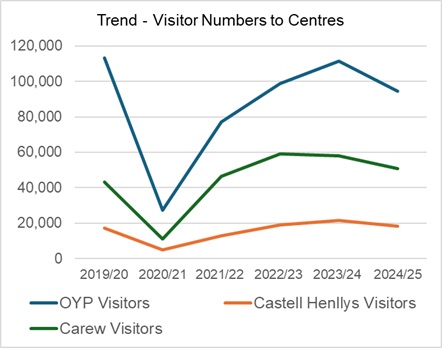
The gallery at Oriel y Parc saw a 42% decrease in visitors from 23,171 in 2023/24 to 13,379 in 2024/25. This decrease reflects the popularity of the Lost Words – Geiriau Diflanedig Exhibition in 2023/24 which provided a boost to visitor numbers. The 2024/25 visitor numbers are within range of figures for 2022/23 (13,259 visitors) and 2021/22 (13,550 visitors).
[1] Tourism Barometer: summer wave 2024 | GOV.WALES
Collaboration Spotlight: Oriel y Parc hosted in partnership with Amgueddfa Cymru and RNLI the Courage and Community: RNLI 200 Cymru exhibition. The exhibition was inspired by the tales of valour from the six lifeboat stations and 13 RNLI lifeguarded beaches along Pembrokeshire’s beautiful but hazardous coastline. It was timed to coincide with the RNLI’s 200th anniversary. Consisting of stories, pictures and artefacts, Courage and Community also featured an Arancia-class inshore rescue craft, offering visitors the chance to get on board, try out some RNLI equipment and have a taste of a rescue at sea. The official opening of the exhibition took place on Saturday 29 June, and included talks, live music and entertainment for younger visitors and families. Water safety formed a key theme at the exhibition, and a drop-in engagement pod was open throughout the day, providing water safety demos and advice.
A new exhibition opened at Carew Castle, showcasing artefacts uncovered at the historic site over the past 60 years. Digging Up the Past offers a fascinating glimpse into the many historical layers of the site, from its origins as a Stone Age settlement to its later use as an Iron Age fort and Norman stronghold. Many of the items originate from archaeological excavations between 1985 and 1995.
Welsh Language Promotion Sessions and Activities
1,827 participants attended learning programme sessions facilitated in Welsh in 2024/25. This compares to 1,441 in 2023/24. This included Welsh words in nature guided walk at Pantmaenog for Ysgol y Preseli with years 7-9. 612 participants attended bilingually facilitated sessions in 2024/25, compared to 29 in 2023/24.
4 participants attended outreach/ inclusion session facilitated in Welsh in 2024/25, compared to 0 in 2023/24. 67 participants attended a bilingually facilitated outreach/ inclusion sessions and activity in 2024/25, compared to 20 in 2023/24. This included an early years celebration day at Castell Henllys with Cylch Meithrin.
47 participants attended community sessions and activities facilitated in Welsh, this compared to 131 in 2023/24. This included practical community volunteering sessions, talks to Merched y Wawr and Welsh language walk for the parishioners of Croesgoch. 1,030 people attended community engagement events facilitated bilingually, compared to 9 in 2023/24. This mainly included practical volunteering sessions and engagement at festivals and shows.
42 participants attended public and visitor activities facilitated in Welsh, this compared to 5 in 2023/24. This relates to a Carningli Circular: Welsh Language Walk and Welsh Language event linked to Lost Words. 28,363 participants attended public and visitor activities facilitated bilingually, compared to 31,634 participants in 2023/24. This mainly related to bilingual events at Castell Henllys, community events and trails at the Centres and art workshops at Oriel y Parc.
Castell Henllys continued to host Can i Plant Benfro in their tipi.
The Authority will carry out work to review its Welsh Language and bilingual offer in 2025/26, including looking at classifications for events, booking information and opportunities linked to the Eisteddfod being hosted in Pembrokeshire in 2026.
Positive Impact Spotlight: One of our most popular events for Castell Henllys is the winter solstice. Referencing historic tales about the gods of darkness and light who ‘fight it out’ during this period, to see if the warmer months are on their way. The event is a bilingual display of music and storytelling, the perfect way of exposing non-Welsh speaking visitors to the use of the language in an engaging and interesting way. The event in 2024 hosted 80 visitors in total, some of whom were return visitors who wanted to bring family members to experience the celebration of the shortest day. The event always includes the Mari Lwyd, an old Welsh tradition.
Approval of Partnership Plan
A new National Park Management Plan was approved in March 2025 and is now called a Partnership Plan for the National Park 2025-2029. The Partnership Plan sets out the purposes of the National Park, key goals, policies together with the action to be taken over the next five years, the partners involved and the measures of success. The Partnership Plan 2025-2029 builds on previous plans, takes account of changes in legislation and policy, and incorporates learning from consultation and from ongoing conversations with partner organisations and stakeholders.
Discussions with partners have provided a strong steer that there should be an overarching partnership or forum to specify, guide and scrutinise Plan achievements. Officer are working with partners to develop this forum. Partners will be encouraged to use the Partnership Plan to inform their own strategies and plans, and to share and celebrate those contributions to National Park purposes.
Th Partnership Plan is based on action across four complementary themes. Each theme has a mission and results they are looking to deliver; these align with the Authority’s Well-being Objectives:
- Conservation – Conserve and enhance landscapes, seascapes, natural beauty and wildlife.
- Climate and Natural Resources – Reduce and adapt to the impacts of climate change. Manage natural resources sustainably.
- Cultural Heritage and Connection – Conserve and enhance cultural heritage, including promotion of the Welsh Language. Enhance equitable access to the National Park and promote the enjoyment understanding and health benefits of its special qualities for all.
- Communities – Foster the socio-economic well-being of the National Park communities in pursuit of National Park purposes.
The Authority produced its first Partnership Framework Monitoring report in 2024/25. This framework will be reviewed in 2025/26 to take account of the approval of the Partnership Plan, with the intention of taking Partnership Framework Standards to National Park Authority for approval.
Next Generation and Youth Committee
The Authority continued to support Youth Committee, with meeting minutes provided to National Park Authority meetings. The Youth Committee have been involved in reviewing Youth Manifesto and provided feedback to Partnership Plan. Two of the groups members attended a youth voice engagement event at Pembroke Town Hall with the aim of sharing information about PCNPA Next Generation with other young people attending. In August the group hosted an event at St Brides Orchard for local youth groups as part of International Youth Celebration Day. The day focused on sharing information about Next Generation and volunteering opportunities for Young People. Around 17 young people attended in total. Next Generation participants have also supported the Authority’s wider inclusion engagement work and attended the Pembrokeshire Pride event held on the Commons in Pembroke in July. Challenges remain in terms of managing natural changes in membership due to young people leaving for education and employment reasons.
Youth Rangers have been involved in practical work included footpath maintenance at St Brides Orchard alongside carrying out an access audit. They have also been involved in a tree planting project in North Pembrokeshire. The Authority has been working collaboratively with Tirweddau Cymru and other Designated Landscapes on future joint engagement activities with young people.
Volunteer Forum
The Authority continued to provide a volunteer forum and provide monthly newsletter updates to volunteers. A volunteer celebration event was held at Carew Castle.
Community Archaeology
The Authority’s community archaeologist has continued to support community based archaeology initiatives. This has included:
- Delivering talk to Pembroke Civic Trust on archaeology in the National Park.
- Delivering activities and events for the public at the Pembrokeshire History Day hosted by Pembrokeshire County Council at Scolton Manor. This included a handling collection display, sand pit and a Heritage Watch display.
- During September, supported a University College London excavation at Crosswell, Eglwyswrw including providing tools and equipment. The community archaeologist delivered public tours to the site. The excavation revealed Mesolithic, Neolithic and Bronze Age archaeology.
- Delivering a joint archaeology guided walk of Skomer with the Royal Commission on the Ancient and Historical Monuments of Wales.
Positive Impact Spotlight: Work was carried out to develop the Arfordir Penfro Lidar Portal. This Portal makes available Lidar data collected as part of the Dawnsio ar y Dibyn project 2021-2023. It has been developed to help increase understanding of known archaeology and improve management of these in the northern section of the National Park. Volunteers after completing an online training course can use the portal to map features.
Collaboration Spotlight: The Authority is part of the Public Services Board Project Group on Strengthening Communities. This subgroup supported through a Shared Prosperity Fund project the development of community wellbeing plans for a small number of communities. The project is led by Together for Change and the steering group supported them to shortlist communities to work with and planning workshops. It is hoped that this work will provide a template to be taken wider to other communities. In quarter 4 work continued on the Together for Change’s Community Wellbeing Plans for St Davids and Crymych. The Ranger Service contributed to the community workshops that were held to support this process.
Supporting Placemaking – Planning Policy and Service
Review of Adopted Local Development Plan 2
A review of Local Development Plan 2 (LDP2) commenced in September 2024. A draft Review Report was prepared and presented to Members on 11 December 2024. A 6 week consultation on the draft Review Report was held from 10 January to 21 February 2025. Officers considered the responses and prepared a Report of Consultation.
The National Park Authority agreed the Review Report for LDP 2 on 26 March. The Review Report was submitted to Welsh Government on 28 March 2025. The Review Report was submitted to Welsh Government within 6 months of commencing the review of LDP 2 in September which is in accordance with the timescale set out in Welsh Government guidance in the Local Development Plans Manual. The Review Report concluded that a full replacement Local Development Plan should be prepared. A Delivery Agreement setting out the timescale and Community Involvement Scheme for preparing a replacement Local Development Plan 3 will be prepared in 2025/26.
Affordable Housing Completions
Local Development Plan 2 policy 48 sets a target to deliver 362 affordable dwellings over the plan period 2016 to 2031. This equates to an annual target of 23 affordable dwellings. The data from the latest Annual Monitoring Report for the Local Development Plan shows:
- There were 22 affordable housing completions in 2024/25.
- Since 2015/16 (Year 1) 232 affordable homes have been completed, which is above the target of 230.
Planning Performance – Local Development Plan
Performance against Local Development Plan 2 is captured in the annual local development plan monitoring report. This report is presented to National Park Authority and submitted to Welsh Government.
Public Consultation on Article 4 Direction
Public consultation was undertaken across 3 months in 2024 and in January and February 2025 on Article 4(1) Direction to remove permitted development rights for 28-day camping, caravan, and mobile home sites within the National Park.
The proposals aimed to address range of concerns around the current situation including the visual impact on the landscape, threats to biodiversity, and pressure on local infrastructure, including problems such as noise, traffic congestion, and other disturbances from nearby temporary camping and caravan sites.
A clarification statement agreed in March 2024 confirmed that the proposed restrictions will apply only to 28-day camping, caravan, and mobile home sites. Other temporary 28-day uses involving development, such as temporary car parks, and mobile saunas will not be affected. Sites operating under exemption certificates or as part of exempted organisations will also be unaffected.
Designation of Cresswell Quay as a Conservation Area
The National Park Authority agreed on 23 October 2024 to designate a conservation area at Cresswell Quay. Public consultation and engagement on the designation was undertaken over an eight-week period from 30 July to 23 September 2024. A total of 17 responses were received to the consultation which were supportive of the conservation area designation.
The designation of a conservation area at Cresswell Quay recognises the special architectural and historic interest of the village and will ensure that future development either preserves or enhances the character and appearance of the conservation area. The designation introduces controls over the demolition of buildings which would require conservation area consent and affords greater protection of works to trees.
At the March 2025 National Park Authority meeting Members approved the draft Cresswell Quay Conservation Area Appraisal and Management Plan for consultation.
Engagement with Community Councils
The Authority delivered an annual training session for all Community Councils in early November 2024 focusing on planning legislation, enforcement and policy. This training is delivered via on-line sessions in the evening to allow for best attendance.
Updated Enforcement and Compliance Policy
Members approved an updated Enforcement and Compliance Policy at the March National Park Authority meeting. A workshop was held with Members as part of the review process. The Policy is a helpful tool in providing clear guidance to complainants and landowners/developers about the processes and policies that apply to investigations of alleged planning breaches.
Planning Performance – Welsh Government Indicators
Planning performance benchmarking data for other planning authorities is available on the Welsh Government Planning pages as part of the development management quarterly survey.
During 2024/25 the Development Management service has focused on addressing older planning applications and has made good progress with this. Addressing older planning and enforcement cases will have a negative impact on timescale related measures. This continues to be the case in terms of our enforcement figures and staff addressing backlog and previous system recording errors.
The Authority has seen improved performance compared to 2023/24 on average time to determine planning applications, they remain below the Welsh average time, except for quarter 4. It has also seen improvements in the percentage determined within statutory and agreed timescales compared to 2023/24, except for quarter 4. However, performance remains below the Welsh average.
A restructure of the team happened in 2023/24 with two area teams created reporting to two Principals Planning Officers as well as the creation of the new Conservation and Enforcement Assistant role which has added strength to the Authority’s enforcement team. These elements have been introduced to improve resilience and outcomes within the Development Management service.
A major planning database upgrade took place at the end of quarter 4 2023/24 and into the start of quarter 1 for 2024/25 which caused significant delays in determination and some reporting issues. It had an impact on the ability of the Authority to deliver its Welsh Government planning performance returns. This issue has been resolved, however challenges remain in terms of current system and its ability to do internal monitoring of individual officer statistics or performance. The Authority is tied to current system until April 2026. Officers are exploring potential alternative providers and seeking additional help from the current provider to try to get workflows and improvements in place.
The new Enforcement Assistant is working well with the 2 officers to streamline the response time for enforcement complaints. However, the wider Planning IT System issues have impacted on monitoring of Officer’s workloads and the team are working on an internal system to work-around this.
Planning Application Workload
532 planning applications were received in 2024/25, this compares to 526 in 2023/24. 464 planning applications were decided in 2024/25, compared to 459 in 2023/24. 39 planning applications were withdrawn or transferred in 2023/25 this compared to 44 in 2023/24.
Planning applications determined within statutory and agreed timescales
Number determined on time
| Quarter | 2023/24 | 2024/25 |
| Q1 | 58 | 101 |
| Q2 | 98 | 105 |
| Q3 | 68 | 82 |
| Q4 | 100 | 77 |
Number not determined on time
| Quarter | 2023/24 | 2024/25 |
| Q1 | 29 | 31 |
| Q2 | 36 | 25 |
| Q3 | 55 | 21 |
| Q4 | 15 | 22 |
Percentage determined on time
| Quarter | 2023/24 | 2024/25 | Wales Average 2023/24 | Wales Average 2024/25 |
| Q1 | 67% | 77% | 84% | 91% |
| Q2 | 73% | 81% | 85% | 90% |
| Q3 | 55% | 80% | 83% | 91% |
| Q4 | 87% | 78% | 87% | 90% |
Average time to determine planning applications
| Quarter | 2023/24 | 2024/25 | Wales Average 2023/24 |
Wales Average 2024/25 |
| Q1 | 121 | 98 | 105 | 106 |
| Q2 | 123 | 99 | 110 | 106 |
| Q3 | 123 | 96 | 114 | 125 |
| Q4 | 139 | 134 | 116 | 110 |
Appeals Dismissed
% appeals dismissed
| Quarter | 2023/24 | 2024/25 |
| Q1 | 100 | 100 (1 out of 1) |
| Q2 | 100 | 100 (1 out of 1) |
| Q3 | 100 | 66.67 (2 out of 3) |
| Q4 | 100 | 66.67 (2 out of 3) |
The Authority faced one judicial review challenge to a decision in 2024/25, with the outcome of the challenge to be determined in 2025/26.
Decisions made contrary to Officer Recommendation
In 2024/25 there were 2 decisions made contrary to Officer recommendation this compares to 1 decision made contrary to Officer recommendation in 2023/24 (revised figure).
Enforcement Cases and Positive Action Taken
Total Number of Enforcement Cases Investigated
| Quarter | 2023/24 | 2024/25 |
| Q1 | 27 | 28 |
| Q2 | 32 | 41 |
| Q3 | 33 | 21 |
| Q4 | 16 | 24 |
Number of cases investigated in 84 days or less
| Quarter | 2023/24 | 2024/25 |
| Q1 | 24 | 13 |
| Q2 | 25 | 24 |
| Q3 | 24 | 12 |
| Q4 | 9 | 12 |
Number of cases investigated in more than 84 days
| Quarter | 2023/24 | 2024/25 |
| Q1 | 3 | 15 |
| Q2 | 7 | 17 |
| Q3 | 9 | 9 |
| Q4 | 7 | 12 |
Average time taken to investigate enforcement cases in days
| Quarter | 2023/24 | 2024/25 |
| Q1 | 91 | 226 |
| Q2 | 466 | 168 |
| Q3 | 139 | 154 |
| Q4 | 238 | 331 |
Average time taken to take positive enforcement action in days
| Quarter | 2023/24 | 2024/25 |
| Q1 | 118 | 398 |
| Q2 | 466 | 188 |
| Q3 | 98 | 54 |
| Q4 | 413 | 411 |
Planning Performance – Additional Indicators
There were 23 applications for works to protected trees determined in 2024/25, compared to 32 in 2023/24. 1 new tree preservation order was made in 2024/25, this is the same as in 2023/24. The % of buildings at risk, based on Cadw survey remained at 5% in 2024/25. 29 listed building applications were determined under CADW delegated scheme in 2024/25, compared to 25 in 2023/24.
Statement of Effectiveness
Through developing regenerative tourism vision and principles, the Authority has created a framework to inform its future work in this area. Wider developments across the Authority should support the development of regenerative tourism action plans across the centres going forward. Collaborative working remains crucial in terms of recreation management in the Park and supporting visitor safety.
The Authority continues to engage with a range of community groups across the Park, with its centres and events programme contributing to cultural opportunities in the Park. Further work needs to be carried out to explore how we can enhance our Welsh Language Promotion offer, with the Eisteddfod being held in Pembrokeshire in 2026 offering a good opportunity to further develop our approach.
The review of the Partnership plan and the creation of the Partnership Plan Forum provides an opportunity for us to further develop collaborative approaches and solutions with stakeholders.
Planning services and Local Development plan continue to play an important role in delivering our communities objective, including supporting affordable housing completions. Work is ongoing to improve planning performance and issues that have arisen following the system upgrade.
Corporate Areas of Change
Our corporate activities for improvement are informed by:
- Improvement actions identified in the Annual Governance Statement.
- Delivery Plans on:
Governance and Decision-Making
Skills Development and Training
Resources and Broadening our Funding
Communications and Marketing
Digital Transformation
- Risk Management and assurance monitoring against compliance and corporate improvement areas.
- Audit Wales and Internal Audit reports.
Corporate Areas of Change Progress 2024/25
Note: Areas relating to Decarbonisation and Sustainability are covered under Conservation and Climate Well-being Objectives.
Finalise set of revised values for the Authority
The Authority made limited progress during 2024/25 in terms of finalising a revised set of values. This is due to focus on other priorities such as the Pay and Grading Review. Previous work carried out with staff on values needs to be revisited. To assist with progressing this work it will be linked to the updating of the Employee Code of Conduct/ Manager Behaviour Framework ensuring that they incorporate a final agreed revised set of values.
Integrated Assessments
In 2024/25 8 integrated assessment (includes different assessment stages) were carried out. Where necessary a staged approach was taken with assessments reviewed and updated at different stages of consultation and approval stages. Assessments were carried out on the following:
- Article 4 Direction 28-Day Permitted Development Stage 1 / Stage 2.
- Cresswell Quay Conservation Area and Management Plan (before Consultation) Stage 1/ Stage 2/ Stage 3.
- Equality Plan and Objectives Stage 1/ Stage 2.
- Enforcement Policy (Need for completion identified after completion of trigger document.)
Separate Equality Impact Assessment, Welsh Language Impact Assessments and Well-being of Future Generations Assessments were carried out on the Partnership Plan. These were staged assessments, with stage 1 initial assessment carried out before consultation. They were reviewed and updated post consultation as part of stage 2 before the plan went for final approval.
During the year, staff further developed reports and templates to support the Integrated Impact Assessment process. This included creation of trigger document to support identification of if assessment was required, updating Integrated Assessment guidance and template and formalising and updating sections within the Committee Reports.
The Authority is currently also exploring development of project level checklists and tools to support assessing impact as part of project development.
Corporate Policy Management and Communication
Significant work was carried out to review policies, move them into new template and then publish them to staff intranet in 2024/25. To support ongoing review a new tracker/ forward programme document will be used to manage and assess progress in this area. People Services continued to make progress on reviewing HR related policies. Work on finalising publication scheme in 2025/26 will also help manage publication of relevant policies in HTML format to the Authority’s website.
Member Engagement
Member attendance at Committee for 2024/25 was 81.7%, this compares to 84.81% in 2023/24.
Member Training Plan was agreed by Member Support and Development Committee in April 2024. In developing the following year’s training plan, officers faced challenges due to delays in Members completing personal development reviews, which form the basis of the plan. There was a minor improvement in Member attendance at training to 58.97% in 2024/25 from 56.25% in 2023/24. It remains below 65% target trigger. Welsh Government commissioned 3 training sessions for Members for 2024/25 on:
- Effective Financial Governance.
- Governance of Risk
- Sustainable and Ethical Governance.
However, take up of the Welsh Government training opportunities have overall been low.
The Authority arranged this year’s Welsh Members Seminar which focused on National Parks for All? It provided an opportunity for the Authority’s Members and other Welsh National Park Authority Members to explore barriers and opportunities in terms of access and inclusion for National Parks.
A Wales Member Support Self Evaluation Framework has been developed to replace the Wales Charter for Member Support and Development. Members provided comments to WLGA on the draft framework.
Scheme of Delegation
The National Park Authority approved minor amendments to the Authority’s Scheme of Delegation. The update aimed to support the effective delivery of the Development Management service and avoids unnecessary consideration by the Authority of minor corporate policy amendments and updates.
Complaints Monitoring
The Authority saw a decrease in the number of formal complaints compared to previous years. 8 complaints were received in 2024/25, compared to 16 in 2023/24, and 24 complaints in 2022/23.
2 complaint was referred to the Ombudsman in 2024/25, neither were upheld. A third one was referred but not investigated as it related to an ongoing enforcement matter.
Media and Online Engagement
The Authority has seen a 28% increase in webcast views of National Park Authority Meetings and Authority Committees from 197 in 2023/24 to 252 in 2024/25.
98.73% of media coverage in 2024/25 was neutral or positive, this compares to 96.67% in 2023/24.
There were 528,392 main website users in 2024/25 compared to 476,516 in 2023/24. There were 1,024,822 main website page views in 2024/25 compared to 1,374,007 in 2023/24. However, this figure has been distorted by high number of page views to the Authority homepage and not the whole site.
Zero Based Budgeting and Income Generation
A ‘bottom-up’ approach was used for the setting of the 2025/26 budget with Heads of Service taking responsibility for drafting budgets on a zero-budget basis. Ongoing work is underway with Officers and Members to support mid and long term financial planning, to manage future deficits identified in 2025/26 budget planning and ensure future balanced budgets. This includes looking at income generation, efficiencies and cost savings. A Members income generation group has been set up to assist in facilitating and driving this work forward.
During the year the Authority commissioned an external consultant to explore ideas for increasing fundraising, income generation and business development opportunities.
The fundraising team continued to work across departments to secure funding. Including successful bids to Brilliant Basics, NNF4 and successfully getting through to the second stage of the National Lottery Community fund for the Roots to Recovery follow on Routes to Discovery project. The Pembrokeshire Coast National Park Trust provided £112,318 to the Authority for specific projects, including Pembrokeshire Outdoors Schools, Pathways, Get Outdoors, Beach Wheelchairs and Nature Recovery projects like Birds and the Bees and Wild about Woodlands.
External funding was used to support the filming and production of three promotional films for the visitor attractions.
Movement to a new finance system was agreed, to be implemented in 2025/26.
Procurement and Assets
The Authority approved a new socially responsible procurement strategy and socially responsible and sustainable procurement policy. Work was also underway with external consultants to review the Authority’s Standing Orders for Contracting Procedures following changes to UK procurement legislation.
The Authority also approved an Asset Management Strategy and updated policy.
In September 2021 the Authority approved expenditure on the redevelopment of the “Green” room which holds Authority committee meetings. Work on site commenced in 2024/25 with the portacabins being removed, and building works are due to be completed in 2025/26.
Welsh Language Standards
The Authority received one complaint regarding the Welsh Language in 2024/25, this compares to 0 in 2023/24. It related to recruitment. In response the Authority has reviewed website documentation and will be making references to the ability to submit applications in Welsh and to undertake interviews in Welsh more prominent going forward.
One complaint was raised with Welsh Language Commissioner, however following a response from officers it was not investigated.
A separate report on our performance against Welsh Language Standards is produced every year.
A signage audit was undertaken in August 2024. As a result, some signage which was not bilingual has been replaced.
Positive Impact Spotlight: In October Authority staff celebrated ‘Diwrnod Shwmae’, an event that aims to show that the Welsh language belongs to us all. A cake sale was held in the Llanion staff room during the morning, with all proceeds going to Macmillan Cancer Support. Staff were asked to order in Welsh (with resources available to make it easy) and try out a chat in Welsh while they enjoyed their cakes. A Welsh walk was led by the Authority’s Community Archaeologist giving staff the opportunity to learn some simple nature-inspired words.
Safeguarding
Continuing trend from 2022/23 and 2023/24, there were no safeguarding incidents in 2024/25.
Most outstanding internal audit actions for safeguarding were completed in 2024/25, including updates to Safeguarding Policy and provision of an annual report. One action remains and this should be concluded once Authority’s Safeguarding Group undertake Group C training course for safeguarding managers.
The Authority updated its recruitment policy which includes sections on DBS checks and DBS procedure.
Revised Equality Objectives and Strategic Plan
During 2024/25 the National Park Authority approved an updated set of Equality Objectives and revised Strategic Equality Plan. Members were provided opportunity to comment on the plan at the September National Park Authority meeting and staff and public consultation was also carried out. A supporting evidence document was developed as part of the review process. An Easy Read version of the Equality plan was produced.
The Authority approved an updated Equity, diversity and inclusion policy in 2024/25.
Equality performance is captured under separate Annual Equality Report required under Welsh specific equality duty.
IT Governance
Formal IT Strategy was put in place and presented to Audit and Corporate Services Committee.
Revised ICT User policy and Information and Data Security Policy was approved by Members at May National Park Authority meeting.
The request to fill form for recruitment has been updated to take account of IT costs.
A new IT/ Systems Project request form and process has been developed. This 2 stage process will also help ensure data protection, web accessibility, Welsh language, use of Artificial intelligence are considered when staff request new systems. The form and process will be piloted in 2025/26.
A business continuity exercise was carried out focused on cyber security incident.
Review of Cyber Security and Data Protection Training
To improve completion rates for Cyber Security and Data Protection training, officers have been exploring delivering this training through ELMS online training platform. They are currently on a different online platform, which makes monitoring and chasing outstanding training harder. Using ELMS will also support this training being integrated into the induction process and enable more staff to access it. This work is due to be progressed in 2025/26.
Data Protection and Record Management
7 data protection breach incidents were recorded internally, compared to 8 in 2023/24. The Authority self reported one of these incidents, which was a historic incident to the Information Commissioner’s Office. Based on information provided no formal enforcement action was taken by the Information Commissioner’s Office. An action plan was put in place in response to recommendations made by Information Commissioner’s Office.
12 data protection impact assessments were completed in 2024/25, compared to 2 in 2023/24. This reflects an increase in requests for new IT related systems and tools in 2024/25.
In terms of record management work continued with restructure of the F Drive. Progress was made in Q1 and Q2 but slowed down in the latter part of the year due to staff capacity. Work in this area is being aligned with wider work on use of Microsoft 365 Sharepoint and Teams and will be ongoing in 2025/26. An internal record management group is in place to support this work and the Authority’s Data Protection Officer sits on the group
IT continued to deliver Microsoft 365 training and worked with planning department on setting up system for working on reports and improving related workflows. The management of Health and Safety Risk Assessments is now done through Microsoft 365 Teams/ Sharepoint.
An updated Retention Schedule was approved by Management Team and Record Management and Retention Policy approved by National Park Authority. Work on updating records of processing is planned for 2025/26.
Officers have commenced work to update the Authority’s publication scheme.
Information Governance
The Authority had 13 Freedom of Information Requests in 2024/25, compared to 12 in 2023/24. 100% of responses were provided within required timescales in 2024/25 carrying on the trend from 2023/24. The Authority had 15 Environmental Information Requests in 2024/25, a decrease compared to 26 in 2023/24. 100% of responses were provided within required timescales, carrying on the trend from 2023/24. The Authority had 1 Subject Access Requests in 2024/25, however a response could not be provided as no response was received to request for verification.
Pay and Grading Review
People Services carried out significant work to progress and complete the pay and grading review. This included working with West Midland Employers on
- Evaluation of posts and independent quality assurance of job evaluation reports.
- Delivering training days delivered and holding moderation panels.
- Finalising a hierarchy of points, taking account of moderation panels recommendations.
- Pay modelling against new hierarchy of points.
- Ongoing engagement and consultation with UNISON during the process.
- Communication to staff the outcome of the Pay and Grading review on their individual post.
- Completion of informal and formal appeals by end of March 2025.
Following this work has been carried out on gender pay gap analysis, which is to be reported in 2025/26.
Due to completion of pay and grading review being a priority for People Services team, limited progress was made on other areas due to capacity. Work on review of induction, updating annual appraisal process and development of training plan are expected to progress in 2025/26 following the pay and grading review being completed.
Pathways to Employment
The Authority has continued to engage with local schools and college to highlight career opportunities within the Authority.
This includes discussing with students job opportunities and the entrant level qualifications that might be helpful with career aspirations to work for the Authority in a wide range of posts. This has included career events at Ysgol Penrhyn Dewi, Ysgol Caer Elen, Ysgol Preseli, Henry Tudor School and Pembrokeshire College and has included senior managers attending the events.
Team Leaders and managers met with Pembrokeshire College Staff to gain insight into suitable roles for work placements and the limiting factors. A successful 1 week work placement took place with Countryside Management and a Pembrokeshire College Student.
HR officers liaised internally and with Swansea University to identify potential opportunities and workstreams for student placements. A history undergraduate from Swansea University undertook a work placement working with the Authority’s Community Archaeologist. They were involved in helping catalogue material previously recovered from the Carew Castle excavations.
The Authority supported an Officer to take part in the Future Generations Leadership Academy. The Leadership Academy is a programme designed to equip young people in Wales with leadership skills, helping them implement the Well-being of Future Generations Act in their communities and workplaces. It offers a mix of online and in-person training, focusing on long-term thinking, social responsibility, and sustainable change. Participants, aged 18-30, gain mentoring, leadership development, and the opportunity to create impactful change plans within their organisations.
Absences and Health
During 2024/25 the Authority reviewed its Long-Term Sickness Absence Policy and HR delivered a training session for line managers on the policy. The Authority has in place external Occupational Health provision which is accessed to support staff to return and remain in work.
The number of days lost to sickness absence including long -term sickness absence was 1,016 in 2025/24, compared to 718 in 2023/24. The number of days lost to sickness absence excluding long term sickness was 495 days in 2024/25, compared to 445 in 2023/24. The % hours lost to sickness absence per employees, including long term sickness was 33.46% in 2024/25, compared to 23.56% in 2023/24. The % hours lost to sickness absence per employees, excluding long term sickness was 16.16% in 2024/25, compared to 14.87% in 2023/24.
2 RIDDORS were reported to the Health and Safety Executive in 2024/25, the same number as in 2023/24. Both were investigated and the Risk Assessments and working practices reviewed.
Authority purchased the Reactec R-Link vibration monitoring equipment to monitor staff’s Hand and Arm Vibration Syndrome exposure. Staff have been provided with training in support of implementation.
A new process was developed to support the review and updating of health and safety risk assessments. As part of this process risk assessments were standardised, evaluated and stored on a new risk assessment Microsoft Teams, with pdf versions then uploaded to the staff intranet.
The Authority is working on embedding a social partnership approach through positive and proactive engagement with recognised Trade Union Unison alongside working with staff through Staff Representative group. The Staff Representative Group provides the Authority with an opportunity to gain feedback from staff. Staff union representative sits on this group. Union Representatives attend and participate at Employee Forum meetings between staff and Members. Officers met with the Unison to discuss how to develop a social partnership approach with them. Union was involved with the Pay and Grading Review and a Union representative is a member of the internal job evaluation panel.
Glossary
- EV – Electric Vehicle
- IT/ ICT – Information Technology / Information and Communication TechnologyLDP – Local Development Plan
- NNF – Nature Networks Fund. This fund is administered by National Lottery Heritage Fund and aims to strengthen the resilience of Wales’ network of protected land and marine sites. NNF4 – round 4.
- Q – Quarter
- RIDDOR – Reporting of Injuries, Diseases and Dangerous Occurrences Regulations
- SAC – (Marine) Special Area of Conservation
- SDF – Sustainable Development Fund
- SLSP -Sustainable Landscapes, Sustainable Places Fund
- SSSI – Sites of Special Scientific Interest
- WLGA – Welsh Local Government Association